 Housekeeper
Plan your kitchen visit
Oven Cleaning in Earl's Court
Give us the address as it appears on your door and identify the oven inside. A visit to a raised ground-floor flat in Earl’s Court may use a different entrance from one to the garden level of the same house. With the access and appliance information together, we can discuss which parts you want considered and who will show them on the day.
What entrance details help near Earl’s Court station?
Give the full SW5 postcode and specify the residential street or side entrance.
Can my letting agent arrange access to the oven?
Yes. Tell us who will open up and share the oven and accessory details with them.
Give the approach with the street door at the centre of it
The Royal Borough’s Nevern Square appraisal describes Earl’s Court station with frontages on Earl’s Court Road and Warwick Road. If you use the station as a reference, say which frontage is closer to the entrance and use the actual residential door as the place to meet. Give the full SW5 postcode, street and number, followed by the name displayed at a shared gate if useful. At a building where a brass plate gives a name beside the bell, include the name and the flat number so they can both be recognised.
Describe what happens after the visitor reaches the first door. In a divided house, the flat with the kitchen may be down a separate outside flight rather than reached by the main stair. An upper flat could be beyond a half-landing with numbers displayed on the doors. Tell us where to wait if someone comes down from the property to meet the cleaner. An agent or resident should have the same approach details. Keep information that grants entry in a private exchange once the visit is agreed.
- Give the precise door and full postcode.
- Identify any second stair or approach at a different level.
- Name the person who can open the property.
Identify the oven before passing access to somebody else
Where a flat was supplied with appliances, start with a view of the front and the parts that can be seen with the oven cool and open. A handbook or model label near the door may establish features that are not obvious in a small kitchen photograph. Photograph all the controls that belong with the oven. If there is a second door, describe what you cook in that compartment and whether you want it assessed. If you know the exact model, include it without moving the appliance or pulling it away from its cabinets.
A compact grill may have its own control with a similar layout to the main oven below. Separate the two in your request, including the trays or shelves that move between them. If the appliance is a freestanding cooker rather than a built-in unit, identify how many cavities you want to include. Share that list with someone attending on your behalf. The agent or neighbour can then tell the cleaner which door to open and where the extra pieces have been left, even if they rarely use the kitchen.
Sort a local approach to the right flat
| Arrival detail | What to give | Who can confirm |
|---|---|---|
| Street approach | Entrance, number and full postcode | Resident |
| Shared hall | Bell and correct stair or level | Person opening up |
| Flat door | Door number and kitchen location | Key-holder |
Locate the main cooking deposit without disturbing it
Report where the patch sits relative to the cavity sides and door. A spill at the front can reach the glass, edge and floor and merit a separate description for each area. A mark inside the upper compartment can be identified by its position above or beneath the grill pan. Photograph the wider area after the appliance has cooled. If the lower surface has gone dull or the side liner looks chipped, mention the change separately from the deposit. That information gives us a clearer account of the condition to review.
If a product or cleaning cycle was used previously, give the name where you know it and describe what happened afterwards. You can say that you do not know which product was used if the current appearance was recorded in an inventory. Report whether the residue sits on a fitted lining, a removable tray or an accessible area of the cavity. The cleaner can assess those surfaces and discuss how their finish and condition affect the agreed work. Leave any worn or unfamiliar pieces where they are.
- Describe the mark against a visible edge or guide.
- Report known products or programmes already used.
- Flag coating changes and marks already recorded on the property inventory.
Separate removable oven parts from items in the kitchen inventory
Write down the oven racks, original trays and grill pieces you would like us to consider. A previous occupant may have stored a spare shelf with their own pans. If the inventory names it, check where it now sits and whether it belongs to the oven in use. Describe the position and finish of any shelf that moves on a guide. Leave fitted or unfamiliar pieces in their original places. Let the person at the property know if a requested item is stored elsewhere in the kitchen.
The cleaner can assess removable components and consider dip-tank treatment for suitable pieces. An accessory with a special coating or a loose piece should be identified so its condition can be considered. List a grill tray and its insert separately if both are to be included. Remove personal cookware before the visit and leave space to identify the loose parts you have named. If an incoming tenant will use the appliance after you leave, give the key-holder the item count so they can check the original oven pieces after the visit.
- Check the contents of the oven against the property inventory.
- Name the cavity and location for stored racks.
- Identify coatings and fittings before removal is considered.
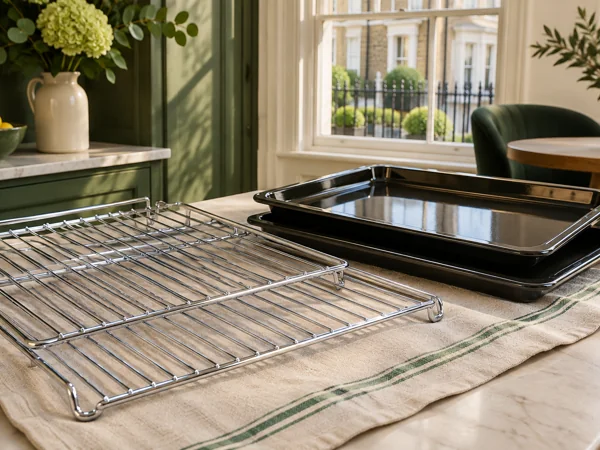
Set out the working room beside a low or high oven
If a low oven sits between other appliances, check how much floor is available with the door open. A corner unit or fixed breakfast bar may leave room on only one side. Send an overall view and describe the route past the open door if the kitchen is shared. Take away loose items such as mats or bins if you can lift them comfortably. If the room contains an older floor or wooden worktop beside the appliance, mention the finish and offer a clear working surface that can be considered.
For an eye-level oven, identify the shelf or counter immediately below its door and other units near the handle. A fixed door or cabinet should stay where it is. Tell us if the room is reached only through a dining area or if you intend to use a separate garden-level entrance. Agree when the oven will be left cool and out of use. Leave the kitchen free of household movement while the appliance and parts are handled, and point out any obstruction you could not move.
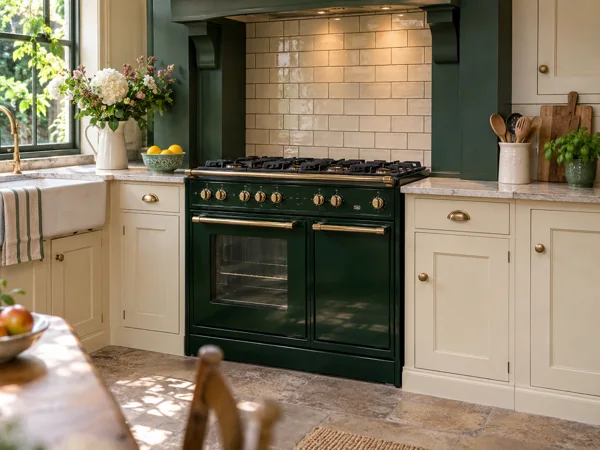
Explain which parts a rental oven still has
| Item | Where to identify it | Detail to report |
|---|---|---|
| Main oven racks | Inside oven or adjacent storage | Number and finish |
| Grill insert | Original grill pan | Part sold or used with it |
| Guides | Side walls of the cavity | Fixed or ordinarily movable |
Specify accessible glass and the controls nearest it
You might see grease on a glass surface or on the trim near a printed setting. Distinguish the position with the door closed and open if the appliance is cool and works normally. If the mark appears behind a pane, give the model and avoid moving the glazing. Access to the different faces varies with the door design and its condition. Tell us about a change to a handle, seal or finish already visible and mention any loose control before the visit. The cleaner can consider the accessible surfaces with those details in mind.
Name any part of the exterior you want included. An oven fitted close to painted cabinets may have a small side edge that blends into the door frame. A photograph with both surfaces in view helps identify the right one. For a top grill and lower oven, name which door or fascia shows the mark, as similar-looking controls can serve different cavities. Record any wear that preceded the request alongside the areas you want considered. That gives the person checking the oven a useful reference at the end.
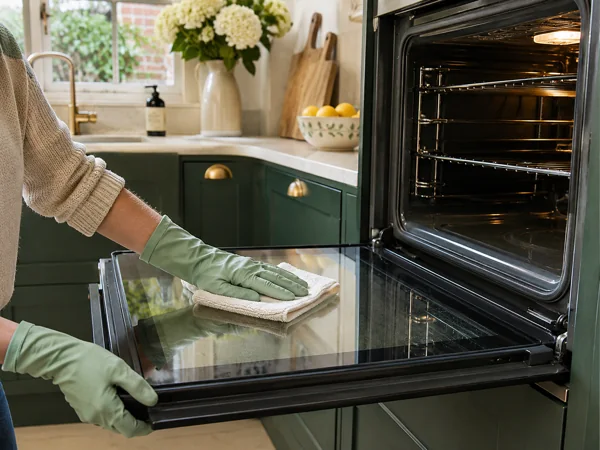
Add the cooking top or hood without changing the oven request
List nearby appliances so the person arranging the quote can talk through each one. If there is grease on a ceramic or induction hob, say which cooking zone or control strip it reaches. For a gas hob, name the supports or burner area and describe the finish around them. Include a separate splashback only if you want to discuss that surface and its material. A wider photograph can show the appliance edges and whether the hob has its own controls or forms part of the range.
If an extractor is fitted beneath a cupboard, report the model if visible and give the position of the canopy and filter. An outer panel with residue and a filter behind it can be listed separately. Describe the material if known and provide a view from below if it is safe to take while standing. The individual details help us discuss which parts can be accessed. Once the quote is reviewed, share details of the agreed hob or extractor pieces with whoever will meet us as well as the oven list.
- Identify the hood or hob separately from the oven.
- Give what you know about the surface or filter.
- Keep the list of agreed parts with the property contact.
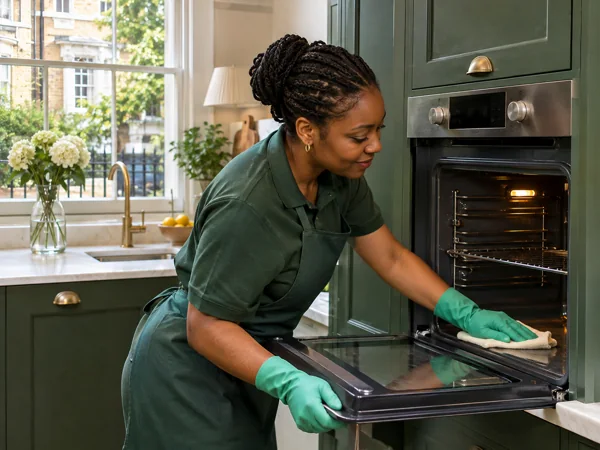
Review the requested oven before returning the flat keys
Tell the person meeting the cleaner how to find the items and the marks you discussed. If they are also responsible for checking the kitchen, send them a copy of the accepted quote and describe the cupboard or tray locations. Ask which removable parts were taken out and which surfaces were accessible. An existing mark can be checked against its location before the clean. If you are returning keys, agree whether the current resident or the agent needs to see the oven before the door is locked.
Ask when the oven is ready to use and let the next person in the property know. Check that the original parts and the handbook are at the property and that extras raised for another date have their own notes. In a flat awaiting new residents, the inventory can use the same cavity and accessory names you gave. A clear handover helps the next user distinguish the main cooker from the adjacent appliance and find the shelves or inserts they will need on moving day.
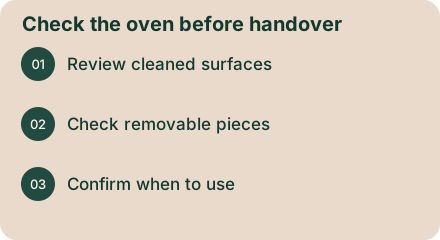
Keep the oven review tied to the handover
| Moment | Record | Person to tell |
|---|---|---|
| Before entry | Which cavity and parts to check | Agent or resident |
| During review | Which marks or items were discussed | Person responsible for inventory |
| After the visit | When appliance can be used | Next occupant |
Get an oven cleaning quote in Earl's Court
Tell us the oven type, number of cavities and whether the hob or extractor also needs cleaning.
Get a QuoteOther Cleaning Services in Earl's Court
Local references · Royal Borough of Kensington and Chelsea, Nevern Square conservation area draft appraisal
Earl's Court oven cleaning questions
Should I send Warwick Road or Earl’s Court Road as the approach?
Use the street where the residential door opens and add the full postcode. Include a station or road reference only if it helps identify the location.
Can an agent name which oven needs cleaning from a photo?
Yes. Send a clear view of its position and controls, with the model or a description of the relevant cavity if available.
What if I find an unused rack after I send the quote request?
Tell us its normal position if known and ask about adding it before the visit. Mention the finish or any visible damage.
Can you assess a stain beside the seal without taking it out?
Give the position and visible condition so we can discuss the accessible area. Leave the seal in place.
How much detail about stairs should I include for an upper floor kitchen?
Name the floor, access point and any tight turns or separate landings. If there is a lift that can be used, explain how to reach it.
Can I make a handover note if my tenant has already moved away?
Yes. Include the keys, the precise oven items agreed and who can review them before the new resident arrives.