 Housekeeper
Mould Removal in Kilburn
For visible mould in a Kilburn flat or house, we look at the exposed finish and agree what can be cleaned. Tell us which rooms are affected and who has access if they are occupied by different residents.
Plan your enquiry
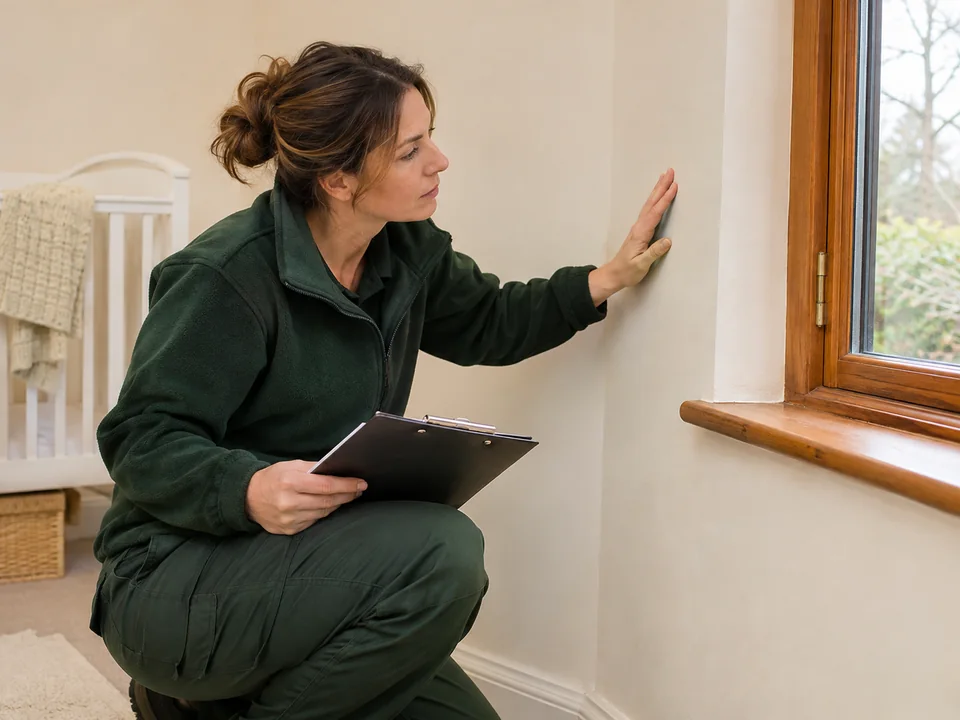
Can I enquire about an NW6 flat?
Send the full postal address, the entrance and the room with the visible mark.
What if several residents share the hall?
Tell us who can open your room and who can give permission for any shared area to be assessed.
Separate an individual room from the shared parts of the building
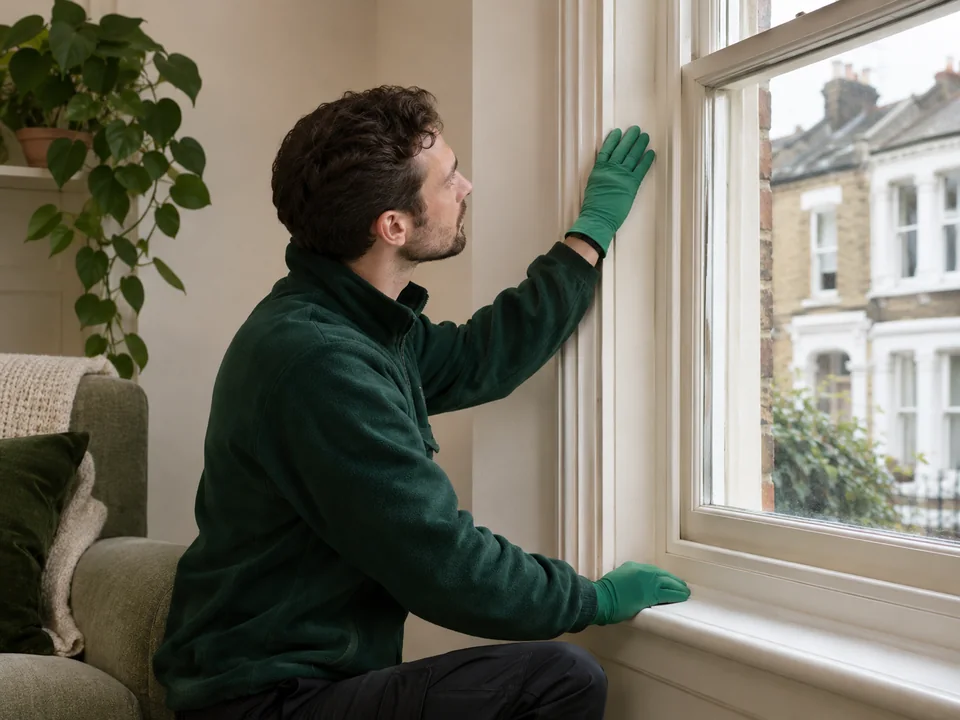
Start by saying which room has visible mould and which household or tenant can let us in. The affected surface could be an exposed hard face within the flat, or something you can see from a shared corridor. Give the position in relation to a fixed feature, such as the tile beside a washbasin or the hard part of the inner side of a window. If you have only seen the mark from one direction, tell us whether the other side of the surface is covered or belongs to a different room.
Brent’s town centre report describes Kilburn High Road, part of the A5, as a boundary with Camden. A neighbourhood name can cover properties on either side. Give us the complete postal address and which entrance takes us to the dwelling. For a flat on a side street with windows facing the High Road, the residential door may be less obvious than the main frontage. Say how a visitor reaches the bell and whether another door needs to be opened by the key holder.
Let us know if the visible patch crosses the edge of a room you use and a part maintained by the landlord or building manager. A mark near a shared window or a dividing door can appear to extend beyond the reach of someone working in one room. We ask for each agreed location separately so we can identify what belongs to the visit and what requires approval of its own. A resident can show the side of a fitting inside their room without assuming that a shared area is available.
If you are sending photos from a property inspection, give the room label and show which side you took each picture from. Where two residents use different names for the same corridor or bathroom, check which description everyone recognises. A picture of a mould mark beside a plain stretch of frame is hard to match to a specific window. Include the closest fixed fitting and the floor so we can refer to the same position during the assessment.
| Enquiry item | Useful detail |
|---|---|
| Address | Full postcode, floor and actual residential door |
| Affected room | Which resident can open it and what we can see |
| Shared area | Which person is authorised to approve access or work |
Prepare the room around the people using it
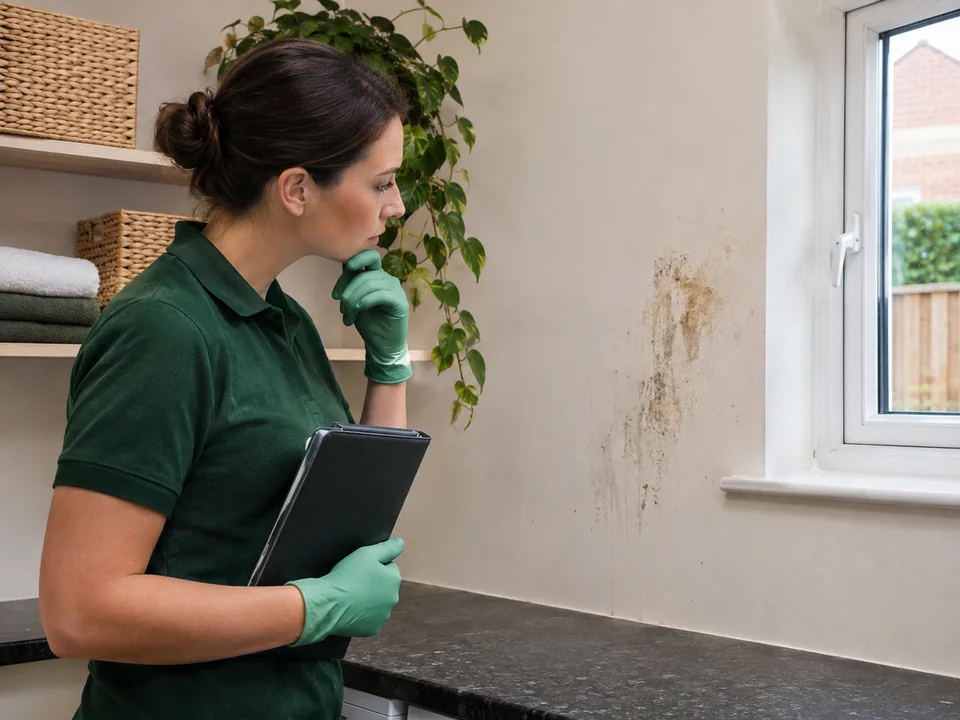
We discuss when the affected area can be made available. When the visible patch is near a window in an occupied bedroom, the resident may be able to move books and other loose items away. A large desk or fitted wardrobe should stay where it is if it cannot be moved safely. Tell us what the room will look like on arrival and whether a resident needs to remain near the affected area during the appointment. We can discuss the best order for the rooms we have agreed to see.
If a shared corridor is the route to a bathroom or kitchen, choose a place for any items moved from the room that leaves the walk through free. Tell us if another flat normally leaves belongings in the hall. We discuss what can be accessed in the existing layout. If a sliding door, long shelf or fixed panel restricts the side of a marked area, explain how far the door opens before it meets the obstacle. Do not move connected or fitted parts.
Agree who can answer any questions when we look at the room. In a property with different residents on each level, one person can let us into the home without knowing the condition of a particular finish. If another resident noticed earlier swelling or a previous repair, ask them to pass that on, or let us know if they will be there. Sharing that detail gives us a chance to consider the actual finish and its history before we agree to clean it.
- Arrange when each room can be opened.
- Keep the common route to the room clear.
- Name the person who can answer questions about the affected finish.
Assess the exposed surface with the agreed access
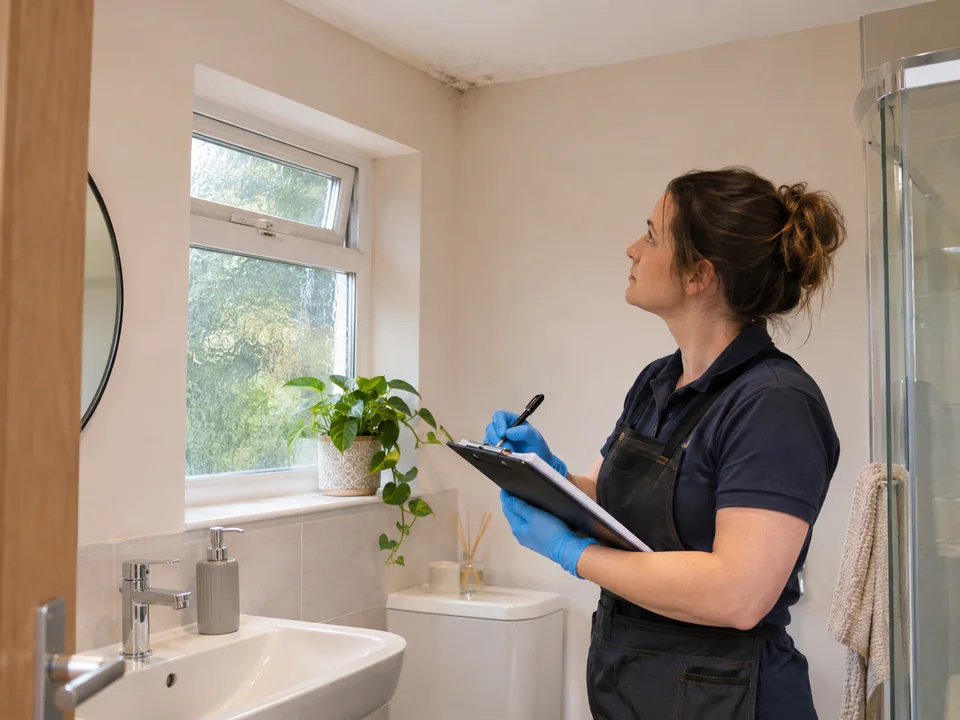
We look at what we can see of the mark and how the finish behaves where it meets more material. A firm hard surface of a frame or tile can sit beside a line of damaged paint or a loose joint. We distinguish those surfaces before we decide which can be cleaned. We also consider which part is accessible from inside the room and where the mark disappears under a fitted facing or onto a surface we cannot inspect.
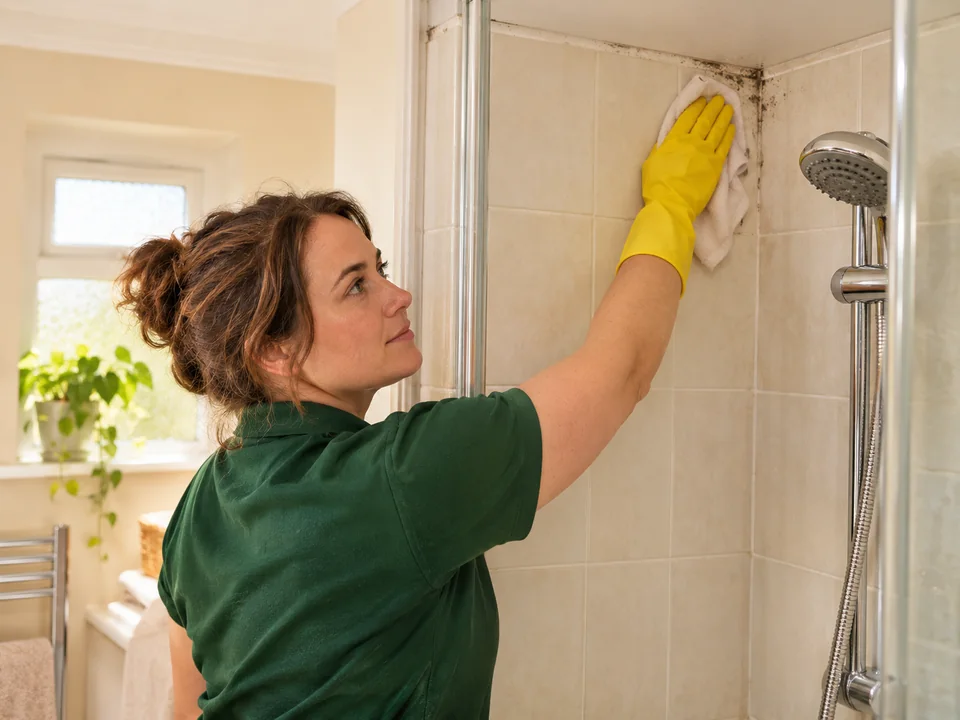
In a flat with a compact shower, a mark around a mounted shelf can be visible from above while the lower face sits behind the fitting. We check the hard areas we can reach from the available position and look for any deterioration at the edge. If the finish appears stable only on one side of the join, we explain that while discussing what can be included. Tell us if the shelf or its carrying parts have loosened or been changed since the mark was first seen.
Although neighbouring occupants might notice marks along roughly the same part of a building, we consider each exposed area we have agreed to assess. Tell us the date or circumstances if you know when marks recurred in your room, and whether another contact is already looking into the building. We can explain what we saw on surfaces in the agreed room. Inspection of moisture passing through a wall or into a covered space is a separate matter for the responsible property contact.
| Exposed condition | Point to establish |
|---|---|
| Sound hard surface | What part of the face can be approached |
| Damaged line beside it | Which material should be left undisturbed |
| Mark beyond the accessible room | Whether another contact needs to arrange assessment |
Clean the suitable hard surfaces that were approved
We remove visible mould on the suitable accessible hard surfaces agreed with you. If the booking is for a mark in one room, we keep the work to its exposed surfaces. A dark line that appears to continue along a frame does not mean we can automatically reach or work on the other side. We check how the line relates to the materials before cleaning the suitable section. We point out where it leaves the face we agreed or where a fixed feature hides the continuation.
If the area was partly covered when you made the enquiry, we may have a clearer view once the room is prepared. We can discuss a newly exposed hard face if it appears suitable. If it belongs to a shared space or a second dwelling, confirm that it can be considered and tell us who would approve it. If it is beside a damaged or loose finish, we review that before asking whether you want the additional face included.
A person who has booked cleaning for more than one occupant may want a single record of the work. We still agree the treatment in each room individually. Different finishes and conditions can lead to different results, even where the marks sit under similar windows. Tell us if you need an update in one room before the next occupant needs it back. We can discuss the order and review the exact faces at the end.
When separate residents open two different rooms, we can use the room and the adjacent fitting as references before we work. The bathroom used by one household may be reached by an upper hall while a ground-floor tenant uses a similar room farther down. Our review can refer to the same entry points rather than assuming the person receiving the update has visited both rooms. Tell us if they need to hear from you first about what belonged to the booking and which common areas were left out.
- Stay with the agreed room and faces unless a change is approved.
- Confirm authority to work in any shared part.
- Check the exact section where the visible mark leaves a hard surface.
Give each resident or property contact the relevant result
At handover, we go through which parts were cleaned, which were only assessed and where the condition of a surface affected the work. For more than one room we use the agreed names and floor. If an edge remains dark beside a cleaned face, we point out its position so the resident can identify it again. If a shared space needs a separate arrangement, we can say where it starts in relation to the room we were in.
Give the property contact a precise description if the mark comes back. A note about the room, floor and nearest fixed feature makes it easier to compare with any other report from the building. Mention whether the mark was newly visible or in the same spot as before. We can describe the exposed work and the condition observed at the handover. Any further inspection can be arranged by the person who manages that part of the property.
To discuss a quote, provide the affected surfaces, number of rooms and full postcode. Explain if gaining entry to one of the rooms depends on a different intercom, key or resident. The practical work can be different for an open stable hard face and a mark whose exposed portion is in a narrow gap. We can discuss the cleaning plan, when the rooms need to be available and who should be there to review it.
- Arrange who will receive the review in each room.
- Identify where the work ended at a common boundary.
- Tell the property contact the exact position if the mark returns.
| End of visit | What we can explain |
|---|---|
| Room access | Which agreed locations were available |
| Work done | The exposed hard surfaces cleaned in each room |
| Future report | The remaining visible location and relevant contact |
Questions about arranging mould removal
What if my window faces Kilburn High Road but the front door is elsewhere?
Send the exact address and describe the door a visitor should use. Give the bell label and the name of the person who will let us in.
Can I include a shared window outside my flat?
Tell us who manages that area and whether they have agreed to access. We can discuss it once you have that arrangement.
Can you assess marks in two separately occupied rooms?
Yes, describe each room and arrange entry to both. We agree suitable cleaning in each room after looking at the exposed areas.
What if the visible mark sits above a cupboard in the shared bathroom?
Tell us what you can see and how you can approach it. We can assess exposed surfaces around the fixed cupboard.
Should I ask another resident about a past leak before the visit?
Share any history you already know. If another resident knows which part was checked, their description can help identify the relevant area.
Can my landlord receive the result instead of me?
Yes, give us the agreed contact and method beforehand. We can explain what was cleaned and any visible limits.
Other Cleaning Services in Kilburn
Regular housekeeping in Kilburn, End of tenancy cleaning in Kilburn
Discuss your mould removal enquiry
Mould Removal Prices in Kilburn
Tell us which rooms are affected, the approximate size of the visible patch and what surface it is on.
Get a Quote