 Housekeeper
Mould Removal in Walthamstow
If you see visible mould near a tiled hearth, on a hard surround or beside a fitted alcove in Walthamstow, show us the surface and its surroundings. We inspect each exposed finish and agree the boundaries before working. We physically remove the visible mould from the suitable accessible hard areas.
Do you take enquiries near Walthamstow Village?
Yes. Include the full E17 postcode and the home entrance.
Can you look at a hard face beside a fireplace?
Tell us which face is exposed and whether there is a screen or a fixed appliance in front.
Inspect the hearth edge and hard surround
A fireplace surround can frame several different materials within a small area. A tile may meet stone at the hearth edge, while the wall on the other side is painted or papered. Take a picture that includes the outer edge and tell us where you see a patch. You may only notice it when sitting in front of the opening, or while standing beside a built-in alcove. Explain where the mark appears in relation to the floor, the surround and any fitted insert. We use the description to separate the hard faces that need assessment.
Waltham Forest Council places Vestry House Museum in Walthamstow Village. If you use the Village as a reference when enquiring, give the full E17 address as well, since the landmark does not identify the route into your home. Tell us which entrance serves your floor or room. If a property has been divided or has two doors next to one another, identify which one you normally use. From that point, explain whether the affected room opens straight off the hall or is reached beyond a separate lobby or part of the house.
We check the hard surround from the room side and follow the mark across any changes in height. A face above the hearth may be reachable while a strip behind a fixed edge stays hidden. Each visible material is assessed before we agree the work. We prepare the space in front of the suitable hard faces and remove visible mould from those areas. The final review uses the hearth edge to show how far the work reached and where a visible continuation was outside it.
There may be previous staining or surface marks in a room with a hearth. Give us the area of new concern and the extent you have seen, with any earlier observations kept separate. If the patch looks different in the morning light, tell us where it appears without altering the room. In person we can compare that area to the adjacent finish before agreeing the surfaces for the visit.
- Put the edge of the hearth or opening in one photo.
- Distinguish a face on the surround from a mark on the wall.
- Say whether a freestanding screen or fixed appliance is present.
| Position | What helps identify it |
|---|---|
| Tiled edge in front of the opening | Which side and whether the tile meets another finish |
| Low recess alongside the surround | View from the ordinary standing space |
| Mark near a fixed insert | What is exposed with the insert left in place |
Plan a clear working position in front of the marked finish
We check the space between the hearth and nearby furniture before agreeing the starting point. A hard return at one side can offer enough reach while the opposite side is blocked. We check both sides against the actual position of the fitment and prepare the suitable accessible section. If a mark runs into a decorative alcove, we assess what is visible there on its own material and condition. At handover we show the exposed section that was cleaned and the fixed detail that determined the edge of the work.
If the appliance is in normal use, tell us that before booking. We need a suitable position to assess nearby hard surfaces and work on them, so we discuss safe access with you and ask that the appliance stays in its ordinary fitted position. If another trade is booked to look at the installation itself, arrange timing so we can inspect the relevant exposed face when the room is suitable for our work. The material may be different if a fitting has been altered between the two visits.
In a sitting room, coverings or furniture can prevent a clear look at a low return. Send an image from the side that is usually free. Let us know if a room connects to another area through a connecting door, and whether that route needs to stay open. We can consider the order in which we assess various positions if only some of the room is available at first. The goal is to check each agreed hard face from a practical position.
If an earlier fitting left a visible opening or an uneven threshold by the hearth, mention it when giving the approach. We will take a look at how the room is laid out before we agree work. A clear passage from the hall is useful, but it does not establish how close we can get to the visible mark. Let us know whether the face is approached from the front, around an adjoining alcove or from a lateral position.
- Check how people normally move through the room.
- Point out fixed parts that affect working access.
- Tell us which times the exposed area can be clear.
| Working layout | Question to resolve |
|---|---|
| Low hearth beside doorway | Clear standing area and continued access |
| Set of shelves beside marked face | Reach with the shelves in their normal position |
| Another trade attending the appliance | When the exposed surface will be available to inspect |
Assess each exposed material and agree the cleaning area
We look at the hard faces in daylight or the ordinary room lighting and identify the relevant joins. A hard tile may be sound where it meets one edge and have a cracked or fragile corner at the other. We assess each part before agreeing where to work. If there is a loose strip attached to the surround, we explain how it changes the reachable area. A different adjoining material can have its own condition even when the patches are close. We confirm the exact section you want us to focus on instead of using the whole opening as the boundary.
Once we agree the suitable exposed hard faces, we prepare the immediate working area with you and physically remove the visible mould from those surfaces. We remain within the limits confirmed during assessment. If an edge is damaged or a continuation disappears under an attached part, we stop and talk through the accessible portion. We explain what can be addressed and how we will identify any part that needs separate attention. We can do that using a visible grout line, rim or hard turn rather than trying to describe the whole surround at once.
If the patch is visible around a change in height, we check both surfaces from the available approach. Sometimes the hard top can be reached and the vertical part is obstructed by a shelf or fitted panel. Confirm which face is a priority while we are there, and we can explain what a second assessment might need. If we identify a nearby patch outside the original area, we discuss its finish and reach before agreeing any work on it.
Where a decorative alcove is part of a large wall surround, tell us if one visible hard area was fitted at a different time. Matching colours can conceal a difference in material or a replacement edge. We check the points where each face starts and stops. That allows us to work on a suitable separate section and leave a damaged or inaccessible part for the person responsible to see. If you are unsure which section is original, show where the colour or texture changes in the ordinary light and tell us about any previous work you know about.
- Check which hard face needs attention first.
- Identify damage and adjoining material before we start.
- Agree a clear reference for the point where cleaning ends.
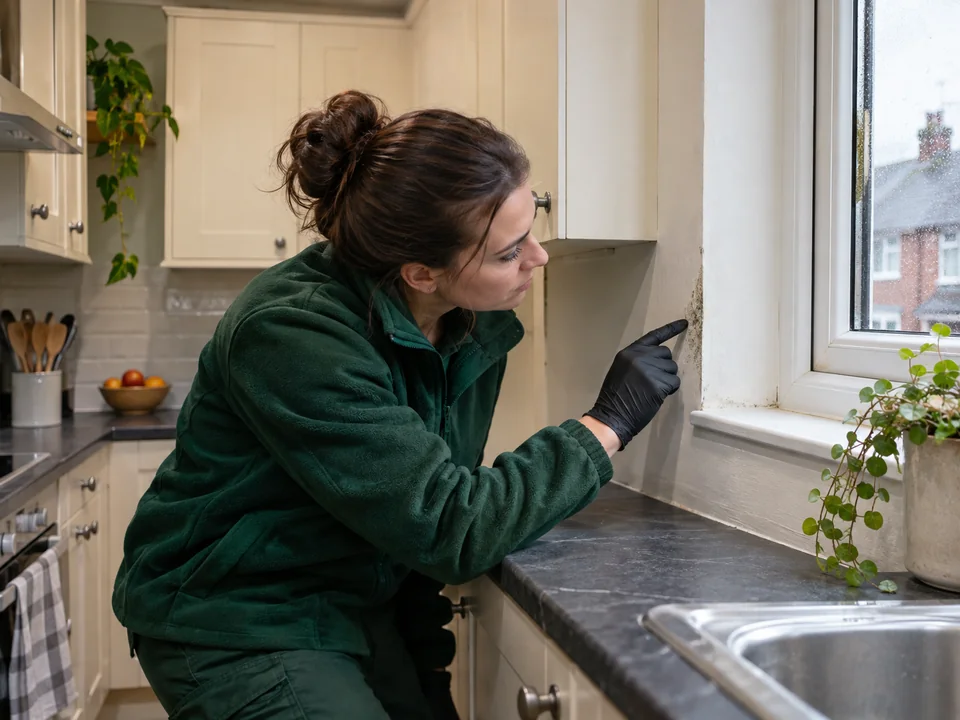
Use the hearth edge to identify what was addressed
We finish by reviewing the work against the available hard faces we agreed. We show where we addressed visible mould and point out remaining staining or damage that can still be seen. If a fixed part restricted access, we show the nearest edge reached. Where the actual mark was on a low face, take the view from the same position that showed the first patch. We can then point to any remaining area on the adjoining finish so that you can distinguish it from a change in colour on the face we worked on.
If you see fresh marking or moisture after the appointment, tell the person responsible for the property the date and exact location. Explain which side of the surround or hearth edge is affected. Give a view of the whole position before sending a closer image, especially if the next person did not attend our handover. We can discuss a further assessment if the exposed hard area changes or another visitor makes more of it available through normal access.
At review we look across the surround from the usual position inside the room. We point to the cleaned part of the vertical face or the surface at hearth level and identify any mark that extended to a different finish. The height change gives a clear reference if someone else needs to inspect it. In a room with a feature on either side of the opening, we identify the treated side relative to the hearth rather than from the doorway alone.
For the final review it is often useful to show the two sides in the same order as when we started. If a resident will describe the result later, ask them to note the side from the perspective of someone standing in front of the hearth. That gives the next person a clear reference without moving loose furniture or a screen.
| Handover detail | Reference to use |
|---|---|
| Hard surface worked on | Exact side and nearest rim or join |
| Face beyond a fixed part | Limit of ordinary reach |
| Fresh change | Date and room position for the property contact |
Questions about arranging mould removal
Can I show you the wall beside the hearth instead of the hearth itself?
Yes. Point out the exact face. We check its finish, condition and access before agreeing any work.
What if an insert partly covers the affected edge?
Leave the fitted part in place and show what you can see. We assess the exposed section.
Can you look at two alcoves at the same visit?
Tell us which hard faces are affected in each and how they are approached. We can discuss both.
Should I report old stain marks as well?
Let us know if an existing mark is beside the visible mould, so we can check the surrounding finish and explain the result.
Can another resident move a screen before you come?
Tell us whether it is freestanding. Agree safe clearance without disturbing the marked surface or altering any fixed fitting.
What if the nearest entrance is through a different street?
Give your full postal address and describe the normal visitor approach separately.
Other Cleaning Services in Walthamstow
Main mould removal service, Enquire about a separate one-off clean
Discuss your mould removal enquiry
Mould Removal Prices in Walthamstow
Tell us which rooms are affected, the approximate size of the visible patch and what surface it is on.
Get a Quote