 Housekeeper
Mould Removal in Romford
If you are arranging a visit for a Romford property with visible mould in several places, tell us who has seen each patch and which area is most urgent for your plans. We assess the exposed hard surfaces and agree where we can physically remove the mould. One visit can be discussed for several locations if the finishes and access are clear.
Plan your enquiry
Do you take enquiries for RM1 and RM7?
Yes. Send the full Romford postcode and house or flat number so we can discuss the address.
Can two occupants show different rooms?
Yes. Agree who can provide access and confirm the work across both rooms.
Give each affected spot a name people can recognise
Where a landlord or housing contact is collecting reports from several occupants, start by asking for the room name and a fixed object near each mark. A back bedroom beside the landing can be unambiguous to a resident, while bedroom two might mean something else on a floor plan. We use the names given by the people who will be there. They help us match the marking to the request when we step inside. If a photo shows only a close-up, ask for a view that takes in the door or complete piece of furniture as a reference. That lets us consider access before we talk about work.
Romford's conservation area appraisal identifies the crossroads of Market Place, High Street, North Street and South Street as central to the historic part of town. For an enquiry in the centre or a home on the other side of the railway, use the full postcode and the actual house or flat number. If the home is reached through another street or alongside a separate business, describe the residential route in a line. Tell us where the door number appears and which door is used for household visits. We can ask about any building arrangements with the person who normally handles them.
Leave a short space in your list for things that people have noticed but cannot see clearly. For instance, a mark on the exposed front of a hall cupboard can be photographed from the doorway. A patch behind its fixed back cannot be confirmed from the same view. We can assess the parts within view and identify an area where further access would be needed. Ask occupants to record what they can genuinely see and avoid guessing that another side has the same marks. We discuss the points separately at the property.
- Give each spot a room name and a nearby object.
- Take a wider picture from the ordinary approach.
- Record any area residents cannot show without moving a fitting.
| Report received | Detail we can use |
|---|---|
| Spot in upstairs hall | Whether it is on the cupboard face or wall beside the door |
| Mark near a shared threshold | Which side is within the home |
| Patch in a back bedroom | Which door leads to that room from the landing |

Prepare each working position in an occupied room
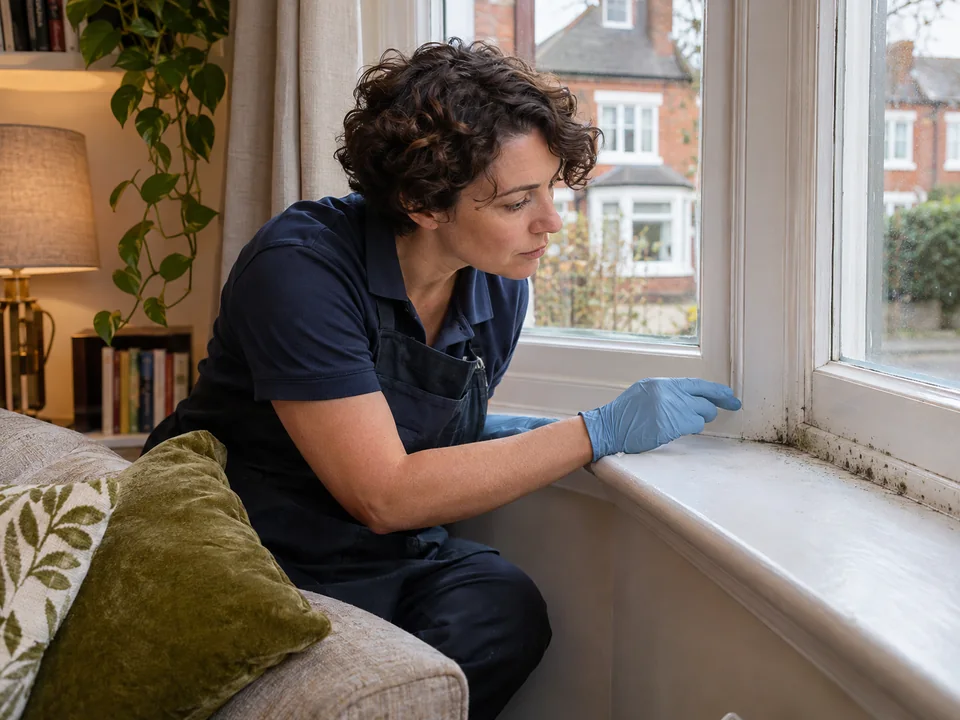
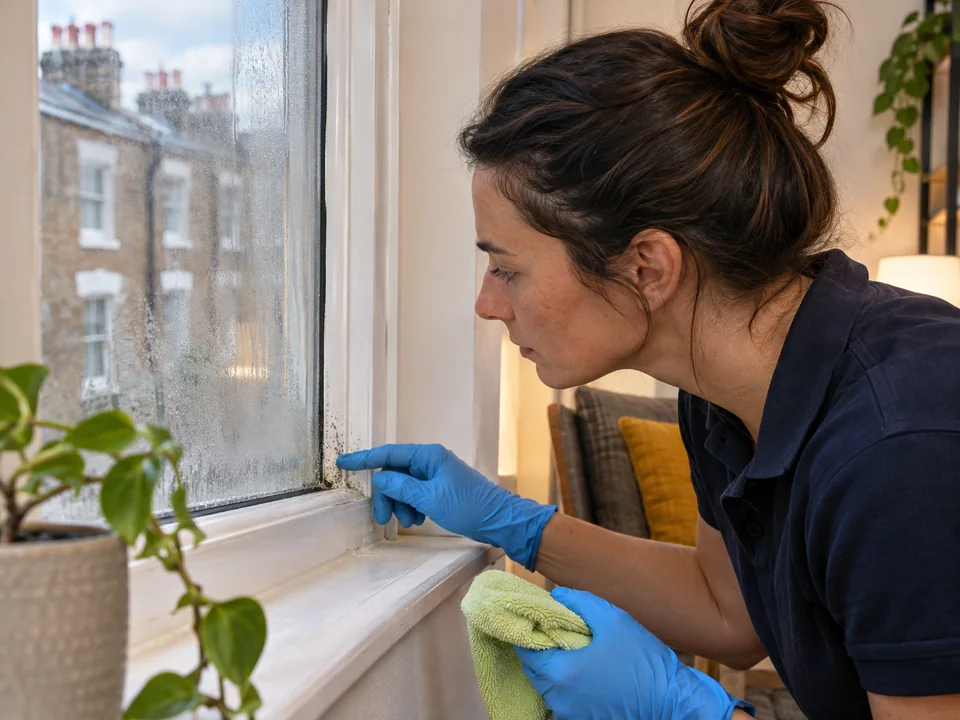
For a room with several reported areas, we inspect each face before setting anything up. The hard return at the window can be workable while a patch of damaged lining near a desk remains unsuitable. We agree which faces can be cleaned and check the available space at each one. We then prepare the working positions in the order that makes access practical and remove visible mould from the exposed hard finishes we have agreed. We show the result one position at a time so the work completed on one surface is easy to distinguish from the assessment of another.
Properties near busy routes may have a different place to stop for an appointment from the usual pedestrian entrance. Give the route normally used for visitors or booked maintenance and mention any steps or low opening on the way. For a shared building, ask the relevant contact about any rules for the way in and how much notice is needed. Confirm whether we meet an occupant at the main door or at the flat. The aim is to know what can be reached and where we can get to work after we have walked through the reported spots.
In an occupied property, we check whether the working position can be kept clear while the agreed face is cleaned. A fixed desk can restrict a corner even where the rest of the wall is open. We assess the exposed hard section beside it and prepare only the space we need to reach it. At review we refer to the desk edge or the nearest visible join to show where the work ended. If another face becomes reachable later, it can be assessed separately.
- Nominate a person who can authorise an adjustment.
- Agree entry to private rooms with the relevant occupant.
- Tell us when a passage or shared room needs to stay usable.
| Access arrangement | Point to confirm |
|---|---|
| Different keys for two rooms | Who has each key and when it is available |
| Arrival through a shared door | Where we meet the person providing entry |
| Working resident present | When the agreed area can be cleared |
Check each finish before removing visible mould
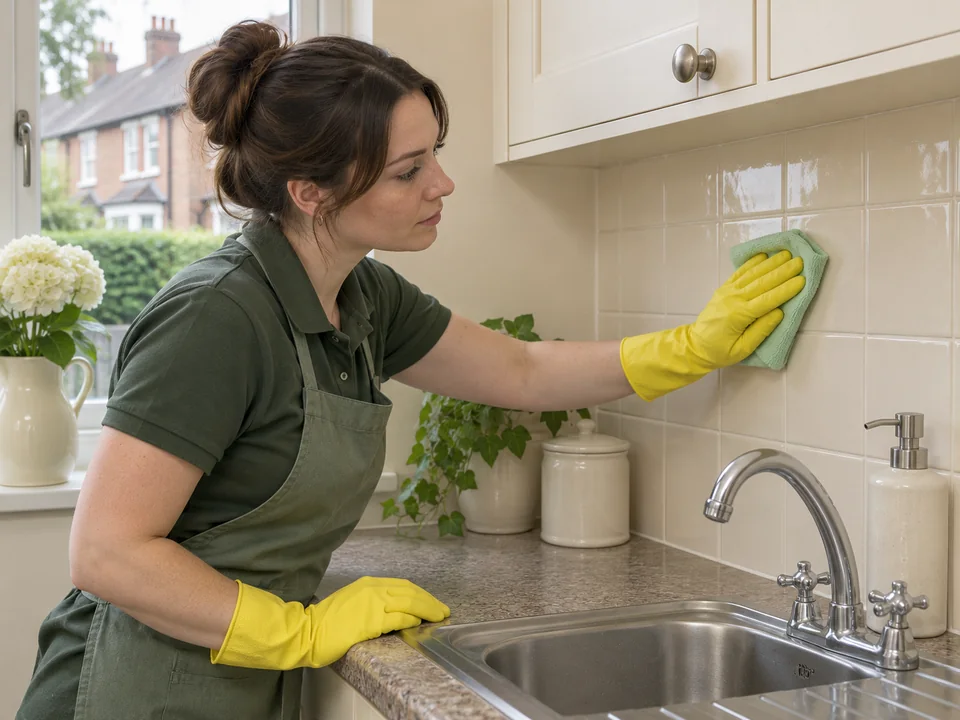
A property can contain sound ceramic, a coated cupboard front and a painted wall within a short route through one floor. When we reach each spot, we look at the finish, its condition and how much of it is directly reachable. We show you the work boundary on the actual surface. If the line of marking extends from tile onto wallpaper, we assess the exposed material on either side of that line. It may be possible to agree cleaning on part of that area, with the other material needing its own attention.
We prepare the immediate space with the access agreed and physically remove visible mould from the suitable exposed hard faces. The condition of a fixing or a surface join can affect the decision as we work. For example, a coating might have lifted near a screw, or the lip of a cupboard edge might be damaged where the front looks intact. We pause and describe that part to the designated contact when it changes the work. There is an advantage to having the contact reachable during the work, because they can confirm the intended area while we can still show them where the change appears.
If two faces meet at an inside corner, we may be able to reach one from the main room while the adjoining face is only visible through a separate doorway. Show us both approaches before we start. We look at how close we can stand, the height of the patch and what lies between it and the ordinary floor position. Sometimes the physical boundary is a fixed item rather than a material change. We can point to the last accessible part and agree where the cleaning ends before preparing to work on that face.
If the closest furnishing is movable, tell us how it is supported and how far it would need to go before anyone changes its position. Some items are attached to prevent tipping, and a fitted cabinet may look like a freestanding piece at first glance. We can focus on what is already exposed and agree how much space is needed for suitable work. Where the occupant has safely cleared an item in advance, show us any change in the type or extent of the surface exposed. We check that additional area before treating it as part of the same job.
- Read through the surface list with us before we begin.
- Point out previous damage near a patch.
- Show both approaches if a corner is visible from different rooms.
Keep one clear account for the handover
We review the completed work against the list of spots shown to us. We can tell you where visible marking remains and what we could not reach or work on. If the person who booked the visit and the person who attends have different roles, agree who will share that account with the other. Describe the area with the same names used at booking. It can be helpful to identify the particular edge we stopped at, rather than saying we dealt with the whole room when you asked us to assess several patches there.
If an occupant later sees a fresh change, ask them to name the room, closest fitting and date observed. That detail can be given to the owner or building contact to review a concern about moisture or damage. Where property work has already been agreed, tell us its timing so we can discuss whether the exposed surface will look different by the time we can assess it. A single record can distinguish the visible condition after our work from a report that came several days later.
At the final review, we revisit the hard faces we cleaned and look at any point where access or the finish put a limit on the work. In a room with matching corners, we give the position relative to a fixed feature such as a window or cupboard. You can then distinguish the cleaned point from another visible spot, even if a different person is shown around later. At a window, for instance, we can point to the side of the sill where its hard face meets the return. Where a mark passes behind a cupboard, we can identify the last reachable part against the front edge that is still visible.
For a building that is periodically empty between tenancies, check how long you will still have permission to enter after the work. Arrange the handover in time to view any points that require another trade or a separate decision. If a future occupant or agent only has a photograph, adding the room, wall or cupboard position makes the message easier to interpret. It also gives them a reference to use if a later change occurs in another part of the room.
A side-by-side check can help if you called about two similar cabinet doors. Use the handle or hinge side to indicate the precise face and ask us to describe what we observed there.
| Record to share | Useful level of detail |
|---|---|
| Face cleaned | Room, fixture and edge of the agreed area |
| Spot unavailable | Reason access could not be given on that visit |
| Remaining surface issue | What is visible and who can review it next |
Questions about arranging mould removal
Can you take one list from several tenants?
Yes. Use agreed room names and nominate a contact who can confirm any changes during the visit.
Can you assess an area through a different entrance from the one in the postcode?
Give the postal address first, then explain the route used to reach the property or affected room.
We only have a photo from an earlier tenancy. Is it useful?
It can help identify the location. We still need to see the finish, the present marking and the available access.
What if one occupant comes home later than expected?
Tell us promptly. We can discuss the order of other accessible spots and explain what can be dealt with while we are there.
Does an open cupboard door give you enough room to work?
We need to see the depth, position and condition of the actual hard face from the open door.
Can you go through the completed areas by room with my agent?
Yes. Tell us who will attend the handover and use your agreed room list when you introduce them.
Other Cleaning Services in Romford
Mould removal assessment and cleaning, Enquire about a separate move-out clean
Discuss your mould removal enquiry
Mould Removal Prices in Romford
Tell us which rooms are affected, the approximate size of the visible patch and what surface it is on.
Get a Quote