 Housekeeper
Plan your kitchen visit
Oven Cleaning in Notting Hill
Give us the exact way into your Notting Hill home and tell us what you want cleaned in the kitchen. At a flat reached from a side street, the address on a map may give only part of the approach. Identify the oven and its working cavities, with any glass or removable accessories you want to discuss.
What should I mention for an address off Portobello Road?
Give the full W11 postcode, actual door and any access restrictions you know about.
Can I request oven cleaning with a short key-holder window?
Tell us when someone will open and close the flat so we can discuss the request.
Give the right entrance around Portobello Road
The Royal Borough’s Portobello Road project identifies the section between Chepstow Villas and Westbourne Grove and publishes information about times and places where vehicle access is restricted. Where the address is near the market, provide the full W11 postcode and the entrance that leads to the kitchen. If the property has a door on a side street or a mews, name it separately from the frontage you usually use to describe the building. Check restrictions for your actual date and say if the cleaner needs directions from a nearby street to the agreed meeting point.
If the kitchen is downstairs from a raised front entrance, describe the steps or alternative door where you want the cleaner to approach. For a flat accessed from a courtyard, give the gate name and say how to reach the correct block once inside. Tell us who can meet the cleaner if the bell or entrance is hard to identify. If an agent has access, provide the name or number that will be visible at the door. Hold back any details that grant entry until they can be passed to the arranged contact privately.
- Use the actual residential approach in the address notes.
- Check any restriction that applies to the specific date.
- Name the resident or key-holder who can meet the cleaner.
Show which oven the request refers to
If the kitchen was fitted out before you took over the property, read the front and any accessible model label. Take a picture showing the controls and oven doors before describing an affected cavity. A double unit may combine an oven and a separate grill. In a full-height cabinet, the appliance above may be a separate combination or steam model. Give the names or positions of the ones you want assessed, plus their usual functions when you can identify them. Keep the units in position when taking the pictures.
If the oven looks unfamiliar, describe what the current resident actually uses rather than assuming functions from the outside. A drawer that holds dishes may not have any heating function. A short list can distinguish the oven, grill and separate cooking surfaces before they are considered. Ask about each working compartment and mention its individual condition if you would like it covered. The manufacturer’s paperwork can also help give a name to a liner or shelf guide where your photographs only show its position.
Give the approach near Portobello Road
| Detail | What to send | What to confirm |
|---|---|---|
| Address | Full postcode and door street | Correct entrance for the kitchen |
| Alternative approach | Mews, side street or gate | Access on the appointment date |
| Meeting point | Name displayed at the door | Key-holder or resident |
Report a grease mark without confusing it with wear
Look at the affected cavity when cool and identify where the mark sits beside the rail, glass or oven edge. A spill pooled on the base may have a distinct shape. Grease at the top of a grill may sit across a wider area. Give the approximate location and photograph the wider surface if useful. A detail of a worn spot can be hard to place unless the larger panel or shelf support also appears. If you are not sure how the mark got there, report the appearance you see now.
Tell us about any product or cleaning cycle previously applied to that area. Give the product only if you know it and add what changed after use. A worn coating or a scratch in the finish can be mentioned independently from nearby residue. We can assess visible grease and baked-on material on accessible surfaces and take the existing condition into account. If the oven is being handed over, the person checking it should be able to recognise the area you meant by the original description.
- Name the compartment and position of the mark.
- Identify a neighbouring rail or seam.
- Report discolouration or treatment you know about.
Check the loose accessories against what is actually present
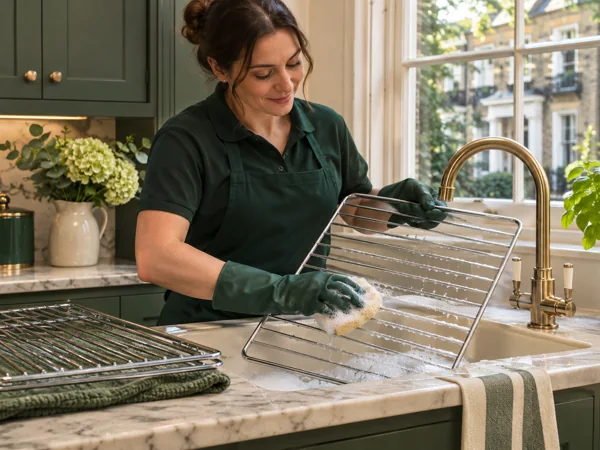
If the cooker came with a grill pan or spare shelf, check whether it is still kept with the appliance. A previous resident might have left it under the sink or in a cupboard near the oven. Give a separate description of each rack, tray and insert you want considered. If more than one appliance uses pieces that appear alike, note the cavity where they normally go. Let the person who opens up know where any piece will be. Remove your own trays and cooking vessels from the oven before the visit.
Suitable removable items can be considered for dip-tank soaking once their condition and construction are checked. If an original coating is visible, describe it. If the surface seems damaged or the handle is loose, mention the issue first. Do the same if a shelf guide no longer moves as it normally would. Leave fixed and difficult-to-move fittings where they are. The cleaner can assess the identifiable items before discussing treatment and use the list to check the parts afterwards.
- List racks and original trays separately.
- Identify the part that lives outside the cavity.
- Mention worn coatings and fitted guides.
Explain the clearance in the room you want us to work in
A kitchen in a flat may have little space beyond the door of the oven. Check when it is cool how far the door opens and which cabinets or table edge sit opposite. Move lightweight loose items from the floor where it is practical to do so. If a fixed counter or appliance restricts where you can stand, describe it before the visit. A picture taken from the open end of the aisle shows the space more clearly than a close picture of the appliance. Tell us which adjacent surface could be discussed for laying out pieces.
Plan for an empty and cool oven. If the kitchen serves as the route to a back door or stairs, tell us when the area can be kept clear of people and pets. Any person meeting the cleaner should know whether they may use a particular sink or counter as agreed. Mention an unusual floor level or edge in the working area. If there is another occupant using a separate cooking surface on the day, say when that part of the room will be free.
Identify cooker pieces found in a flat
| Item | Where to look | What to mention |
|---|---|---|
| Spare rack | Original cavity or cupboard | Count and condition |
| Grill insert | Matching pan | List as a separate part |
| Fixed guide | Oven wall | Any sticking and oven model |
Identify the exposed surfaces of the oven door
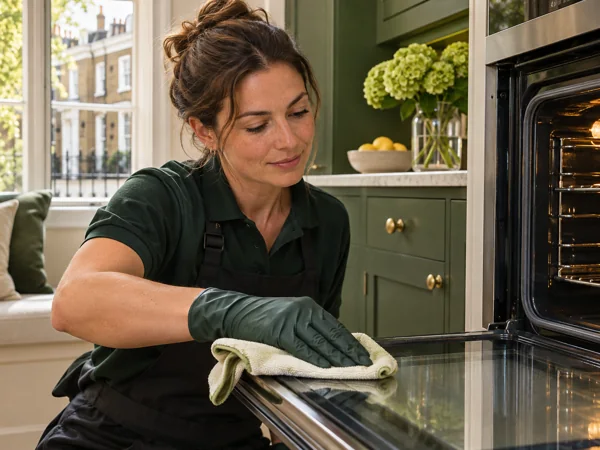
The area around an oven door may include a glass face, handle and metal or painted trim. Locate the marks you want assessed by their position in relation to those parts. If a stain appears between panes, give us the model and the specific door. Access is affected by the design and condition of the glazing. Leave the parts in place for assessment. If a seal or hinge already appears damaged, mention it without trying to detach it, and tell us if grease is also visible alongside it.
For a mark by the controls, explain whether it sits on the fascia or a neighbouring kitchen surface. A photograph of the whole width of the front shows where finishes change. Report pre-existing fading around any selector. Name the upper or lower panel when both ovens have similar controls or glass. We can inspect accessible surfaces depending on the condition you describe and discuss what belongs in the agreed request. Keep the same positions in the item list so you can identify them again when reviewing the appliance.
Add the hob or hood if the inventory also names it
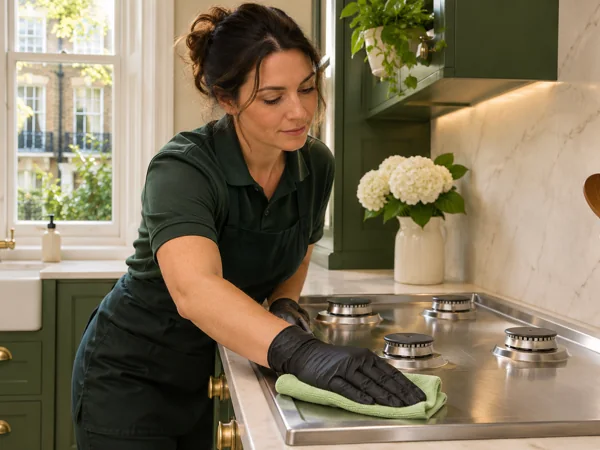
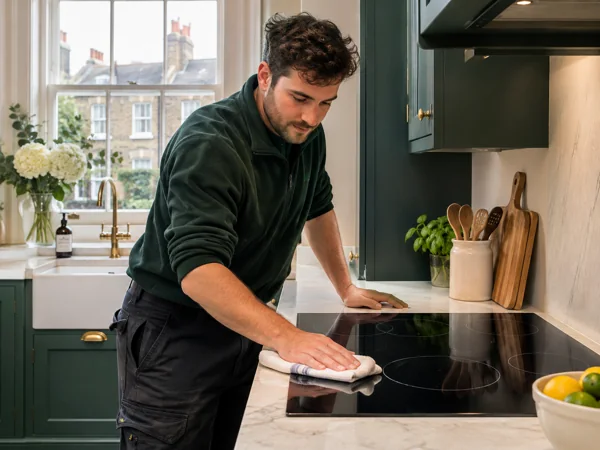
A checklist may group all the cooking appliances under one heading. For the quote, identify them individually. A hob can be gas, induction or ceramic and may have removable supports. Describe the location where grease or residue is visible and give the material of the surface. If the hob was installed separately from the oven, show where it sits in relation to the worktop. Name any additional surface such as the splashback by its finish and ask if it can be considered as a separate item.
A hood or canopy may be exposed or built into a wall unit. Tell us how it is mounted and identify the external area you would like discussed. Give the filter type or model if it is known. If you have no manual, a view from underneath may help identify whether the filter is accessible. You can include the hood as a separate line when you ask about the oven and hob. Tell the person in the property which extras were agreed if they will be reviewing the appointment for you.
- List the hob and hood by type and position.
- Give any known filter detail from the manual.
- Pass agreed appliance extras to the property contact.
Set the oven review within the available key access
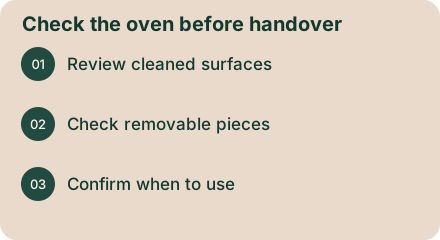
If a key-holder needs to leave before or shortly after the cleaning, agree who can see the oven at the end. Give them the accepted item list including any removable pieces kept elsewhere. Ask which parts were removed and discuss any concern you reported when choosing the visit. If the quoted oven is one of several, use its location to confirm which appliance was included. Tell the person returning to the property what was considered and when it can be used again. This matters where a visitor has to hand keys to an agent immediately afterwards.
Keep the model and original accessories with the property’s appliance information when someone else will take over. If an extractor or second oven was only discussed for later, give it its own list. The next person can then see which items were agreed in the visit and find the original trays without relying solely on the room’s inventory wording. Where building access depends on the market area or a gate, keep the agreed entrance instructions available for the next booking.
Keep the review within key access
| Step | What to record | Who checks |
|---|---|---|
| Open up | Access time and oven position | Key-holder |
| Review | Agreed parts and visible areas | Person at the property |
| Finish | Return to use and keys | Resident or agent |
Get an oven cleaning quote in Notting Hill
Tell us the oven type, number of cavities and whether the hob or extractor also needs cleaning.
Get a QuoteOther Cleaning Services in Notting Hill
Local references · Royal Borough of Kensington and Chelsea, Strengthening Portobello Road
Notting Hill oven cleaning questions
Do I need to tell you about a market street restriction before agreeing a time?
Yes. Check the information for your address and date and let us know which meeting point or route can be used.
Can an agent identify the requested appliance from the kitchen inventory?
Send the oven model or position with the relevant inventory entry. Include the pieces and surfaces you want considered.
What if the oven door opens almost across the whole kitchen?
Describe the aisle and send a view of the sides of the space with the oven in position. Tell us when the room can be clear.
Can I request that a tray be assessed even if the previous resident left it behind?
Yes. Say where it is stored and whether you know its model or coating, so it can be identified before treatment is discussed.
How can I locate a mark on a cabinet beside the oven?
Show the place where the cabinet meets the appliance, name the finish if known and identify the surface separately from the oven.
Can I pass the outcome to my agent before sending back the keys?
Agree who can review the oven and removable pieces and ask when the appliance can be used again. Share the accepted item list with the agent.