 Housekeeper
Detail-led care for your oven
Oven Cleaning in Enfield
Put the oven you use most at the top of your Enfield cleaning enquiry. A wide range may have two full ovens, while a column of built-in appliances may combine an oven with a specialist cavity. Identify the parts you want covered and the finishes around the appliance. We can then discuss the individual items and the space available to work.
What should I send for an address off Church Street?
Give the complete postcode and name the entrance from the street, especially if the kitchen is behind a shared or commercial frontage.
Can I ask for just one cavity in my range?
Yes. Describe its position, the door or controls and the removable pieces that belong to it.
Identify the range from its doors and controls
A freestanding cooker with five doors can look similar across models while offering a very different combination of compartments behind them. Start with the name on the appliance and, if it is accessible, the model label. Tell us which doors lead to an oven, a grill or a compartment you use to keep food warm. If there is a low drawer you use for storage, identify it in the enquiry. Knowing how each compartment is used means we can discuss the parts you actually want included in the visit, wherever they sit in the range.
The same principle applies when cabinets contain more than one oven. A small upper appliance may combine microwave and oven functions or be a dedicated steam oven. Give the name of the individual appliance if the panels have been designed to match. A single photograph of the whole unit can establish the layout, with a close picture of a readable label if necessary. Leave every appliance in position. Let us know if the label is concealed and we can start from the information you already have.
- Identify each cooking compartment.
- Mention combination functions and separate controls.
- Give the model if you can read it without moving the appliance.
Record a finish before describing how it looks
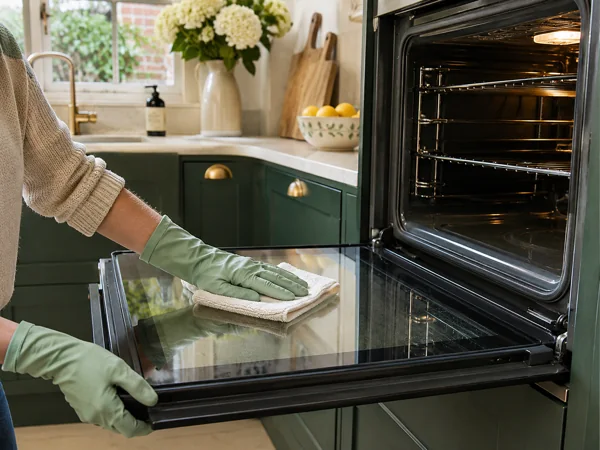
The words black oven tell us the colour but give little clue about the material. An enamel door, tinted glass and a coated metal control panel can all look black in evening light. Give the material where you know it and use a clear photograph when the name is uncertain. Mention any printed temperature markings and any parts that are already dull, faded or scratched. Point out the nearest piece of cabinet or worktop too, especially if there is an oiled timber edge or a polished surface adjoining the face of the appliance.
Original manuals can be useful where an oven front combines parts with separate care instructions. Keep the model and the relevant page handy if the manual identifies a coating, special liner or decorative trim. In a kitchen renovated around an older cooker, the colour of the new cabinetry may make the original finish hard to recognise. Give us the information you have and flag anything you want discussed at the start. A clear record of existing condition makes it easier to talk through the visit when the appliance can be seen.
Identify the doors on your range
| Door position | Use | Relevant detail |
|---|---|---|
| Tall left door | Main oven | Width and rack count |
| Shallow upper door | Separate grill | Insert and catch pan |
| Lower side drawer | Storage or warming | Confirm function and inclusion |
Describe the point where residue has built up
A well-used oven can develop a dark patch under the rack where a roasting dish normally sits, with lighter deposits elsewhere in the same cavity. Describe those positions separately. If a sauce ran down the front wall, say how far it reached and name the affected compartment. For a wide oven, the left or right side is worth noting, especially where the doors look alike from a distance. A picture taken when the oven is cool can record the deposit together with the nearest rail or seam so it can be found on arrival.
Include any previous product or cleaning cycle you know was used on the same area. If the interior looks different since that treatment, explain what changed in your own words. A discoloured patch can be recorded alongside loose residue as an area to assess. Mention exposed chips or lifted material when requesting a clean and leave the surface in its present condition. We can then discuss the appropriate attention for the accessible surfaces and the condition of each cavity without making assumptions about what caused a mark.
- Give the cavity and location of the main deposit.
- Mention products previously applied if known.
- Describe visible changes in the underlying finish.
Treat fitted accessories as individual items
Extra-wide trays and half-width shelves may belong to the same cooker. Give the number of pieces you would like us to consider and the compartment each one came from. Explain if the rack and a tray form a pair, for example where a grill insert normally sits in a deep catch pan. If an oven came with a roasting tray that matches personal cookware, leave a note identifying the original item. That detail is especially useful in a household where the person showing the kitchen will differ from the one who made the enquiry.
Some shelves sit on sliding runners; others lift free from the rail in normal use. State which fittings you know can be removed and which you usually leave where they are. If you use a thermometer or baking stone of your own, put it away before the visit and mention it only if it is relevant to a mark or an area you want discussed. Leave any fitting that seems stuck or unfamiliar for assessment. The model and your list let us ask specific questions about shelves and trays before the work is agreed.
- List racks and pans by compartment.
- Identify rails or supports that usually stay fitted.
- Put personal cookware aside and label any unusual original accessory.
Describe the finishes beside the oven
| Surface | Useful description | Condition to flag |
|---|---|---|
| Fascia | Printed or engraved controls | Faded or loose markings |
| Worktop lip | Stone, timber or another finish | Existing chips or colour changes |
| Floor in front | Tile, board or covering | Change in level or loose edge |
Check the way the oven doors open
When a drop-down oven door is open, it can take up most of the gap between the cooker and a deep island. Check the working space at the side as well as directly in front. If the appliance is a range with side-hinged doors, tell us which way each one swings and where it comes close to a neighbouring cabinet. A cooker installed near a passage may block that route while being worked on. If people normally pass through to reach a garden, utility or lunch table, plan when that path can be left clear.
A stone or timber worktop close to the appliance may be the only nearby surface. Let us know which area can be used by agreement and mention items that usually occupy it, like a hot-water tap, coffee machine or drying rack. Put away loose items you can move comfortably. If floor coverings, plinths or cabinet edges should be taken into account, describe them when sending a wider kitchen photo. We can use that view to discuss access and the parts of the appliance you have named.
Give a complete approach for Enfield Town
Transport for London’s Enfield area map shows the town station near Southbury Road, London Road and Church Street. If the easiest way to describe a property is by the station, make sure the person visiting has the actual entrance rather than relying on what the building overlooks. State the full postcode, the street address and any flat number. At a property that displays a building name at the gate and a number beside the front door, include both in the directions. If you are elsewhere in EN1 or EN2, give the same details for the exact address.
Check where somebody can meet the cleaner and explain the route between that point and the kitchen. For a flat at the rear of a larger building, report when the corridor or stair reaches a second locked door. For a side approach at a house, say if the gate opens into a narrow passage or needs someone in the property to let a visitor through. Where there are private parking arrangements, mention who authorises them. The named person can confirm how to enter and answer appliance questions if you are away from the property.
- Share the actual street entrance and full postcode.
- Describe any further door or landing on the route to the kitchen.
- Explain where to meet if access must be arranged.
Quote the adjoining hob and canopy separately
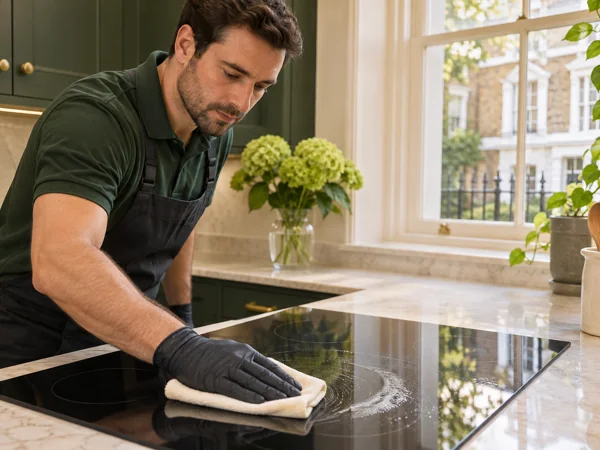
A hob directly above a built-in oven has its own surface, edge and controls. If it is a separate appliance, supply its type and model where known. If it forms the top of a range, tell us what is arranged around it, such as burners, a griddle or a flat cooking plate. List the areas that need attention and any existing change in the finish. For glass hobs, identify marks by cooking zone. For a gas top, describe where deposits sit, including any removable items you wish to consider. This keeps the requested top from being confused with the oven cavities beneath it.
The hood may carry the same manufacturer's name while requiring a different discussion. Report its height or describe access if it sits above a deep range, and say what its outer surfaces are made of if you know. If the filter type is visible from below, include that information. Ask about the extractor as a distinct quote item. Point out any part that is already dented or discoloured, and raise questions about filter access when describing the model.
Prepare access from an Enfield Town street
| Stage | Which information to give | Contact |
|---|---|---|
| Approach | Named street and full postcode | Person booking |
| Outer door | Door number and entry permission | Resident or key-holder |
| Working area | Free space and door swing | Person meeting the cleaner |
Review the agreed items with the appliance in view
After the work, compare the components discussed in your quotation with what can be viewed at the appliance. Start with the cavity you use most. If you requested a separate grill or a second oven, check its parts individually. Use the original list to account for any loose shelf or insert set aside for consideration. Speak up if a mark you raised needs clarification. Someone looking after the property in your place can make the same review if you have sent them the location and names of the agreed items.
Take a moment to confirm any care instruction relevant to putting the kitchen back into use. Keep the manuals for the appliance and any nearby surface when there are different finishes involved. If a second oven needs its own visit later, keep the individual model and note which parts were discussed. Where work was requested before a handover, agree who can see the oven before the keys change hands and pass on the review to that person. The owner or next occupant can use the appliance information without reconstructing the original enquiry.
Get an oven cleaning quote in Enfield
Request a quote with the oven type, number of cavities and any extra appliances.
Get a QuoteOther Cleaning Services in Enfield
Local references · Transport for London, Enfield cycle network map
Enfield oven cleaning questions
Can you identify the larger oven if my range has no readable label?
Send an overall photograph and describe the doors and controls. Give any brand or model information from your manual.
How do I report a patch left after the oven’s own cleaning cycle?
Tell us which cycle was used if known and where the change appeared. Send a picture of the area when the cavity is cool.
Should I include the warming drawer in the cavity count?
Identify it separately, describe what you use it for and say if you want to discuss it as part of the quote.
What if my hood is too high for me to identify its filter?
Give the name or model if available and describe the outside, the height and the area beneath. Leave the filter in place.
Can I show the condition of the cooker without moving it?
Yes. Photographs of the accessible front and cavity are sufficient for an initial discussion. Describe the cabinet spacing from the position you already have.
How do I distinguish the two ovens in my enquiry?
Use their positions and functions, such as the smaller fan oven at eye level and the larger oven under the hob, and name the items you want included.