 Housekeeper
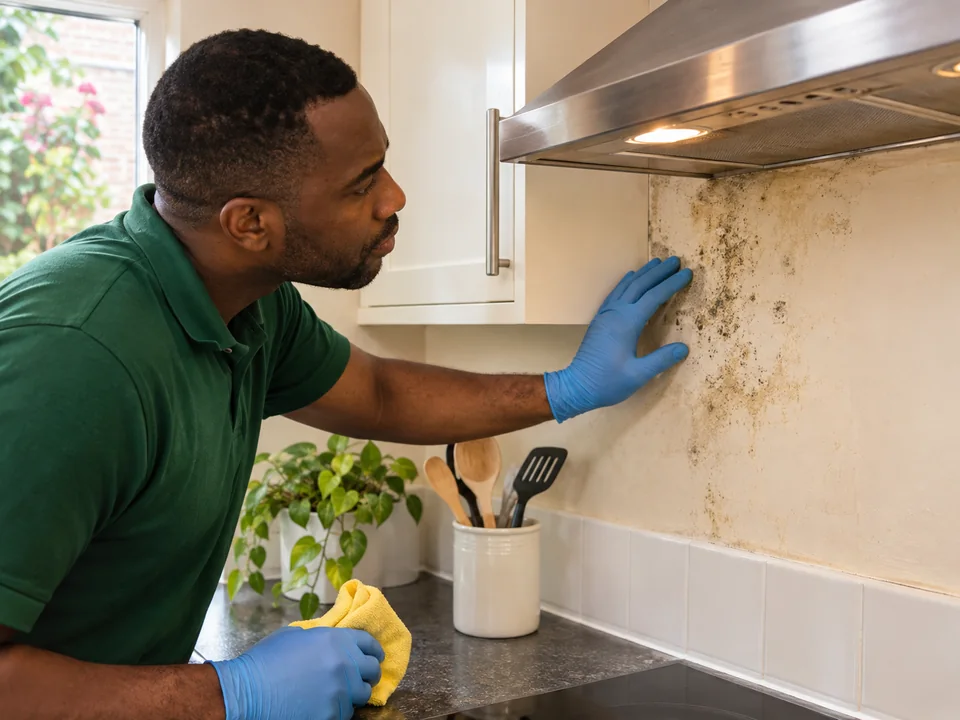
Mould Removal in Fulham
If you can see mould around a Fulham bathroom fitting, kitchen window or other hard surface, tell us exactly where it is. We review the exposed areas with you, confirm what can be cleaned and explain the result at the end.
Can I enquire about an SW6 flat?
Yes. Send the full postcode, floor and affected location so we can discuss the address and the visible surfaces.
What if the rear extension has its own entrance?
Tell us which entrance to use and who can open it.
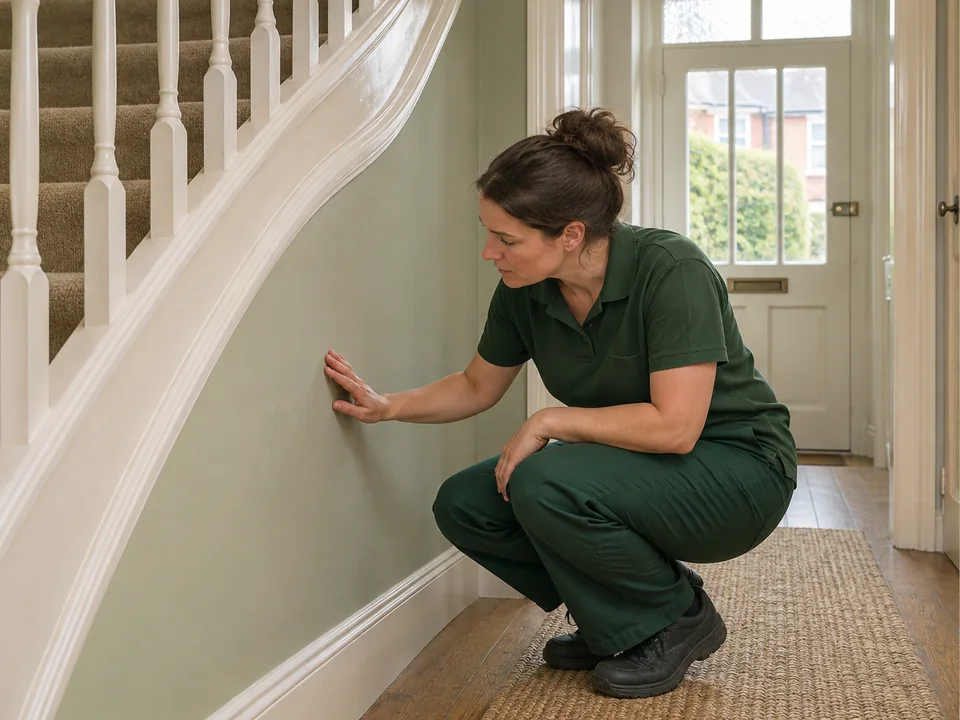
Start with the affected finish, then tell us the route
At the start of a Fulham mould removal enquiry, we want to understand what you can see without opening up a wall or moving a fitting. Give us the room and a simple location within it. A patch at the base of the inward-facing kitchen reveal is clearer than a general note about the rear of the house. Say if the mark is on a painted face, an exposed tile, a hard sill or the joint between them. If you do not know the material, tell us what it looks like and let us consider it when we see the room.
The borough’s local plan lists Central Fulham, Parson’s Green and Moore Park as distinct conservation areas. For a cleaning visit, the practical point is to confirm which property and which part of the building we need to reach. An SW6 address can open onto the original hall while the kitchen in question is in a rear extension, or a converted home may have two different doors at the front. Tell us the door label, floor and any steps below street level. That lets us distinguish the postal address from the actual route into the work area.
If a photograph shows the affected reveal but omits what is in front of it, add a wider view if you can take one from a normal standing position. Include a full view of a screen, fixed cabinet or radiator if it limits where someone can stand. Please leave heavy or fixed items in place. The booking discussion is about which areas we can reasonably inspect and how to approach them when the house is ready for us.
| First enquiry | Useful detail |
|---|---|
| Postcode | The complete SW6 postcode and dwelling number |
| Room | Rear kitchen, shower room or another named room |
| View | An exposed face and anything restricting the approach |
Plan a clear working area around the marks
We agree which loose items should be put aside before we begin. In a side-return kitchen, dishes left at one end of the window ledge can be easy to move while a coffee machine close to the area needs a space of its own. In a shower room, bottles and baskets can be put away before we assess the walls around them. If an independent cabinet is too heavy for you to move, let us know where it stands in relation to the mark. We can consider the amount of the surface that remains exposed.
Where a staircase and hall are shared, say if a resident or managing agent needs to approve the use of a side entrance. The person who arranged the cleaning may arrive later than someone who can first answer the door. Ask them to show us the intended room and how to reach it. If you cannot attend yourself, confirm who knows the area you agreed to have assessed and who can answer a question about a sensitive finish.
We also discuss what you need to keep using while the visit is underway. In a narrow kitchen, a row of lower cabinets or an island may reduce the approach to the affected side. The same stretch of floor could be the only access to the back door. In a compact room with an inward-opening door, tell us beforehand if it needs to stay available to other people. Agreeing the order at the beginning gives everyone a clear plan for access.
When a fixture occupies the corner, tell us about the distance between its outer edge and the affected patch. From a photo it can be hard to tell whether someone can actually reach through that gap. Say if the bathroom cabinet doors can swing back fully, or if a neighbouring wall stops them halfway. We look at the space as it is normally used and confirm how much of the exposed material can be approached. The preparation should leave the agreed surface available without dismantling items or moving possessions that belong to other residents.
- Identify anything you want left in its current position.
- Keep food, utensils and toiletries clear of the area agreed.
- Check who will let us into any room with separate access.
Review hard surfaces and their adjoining finishes
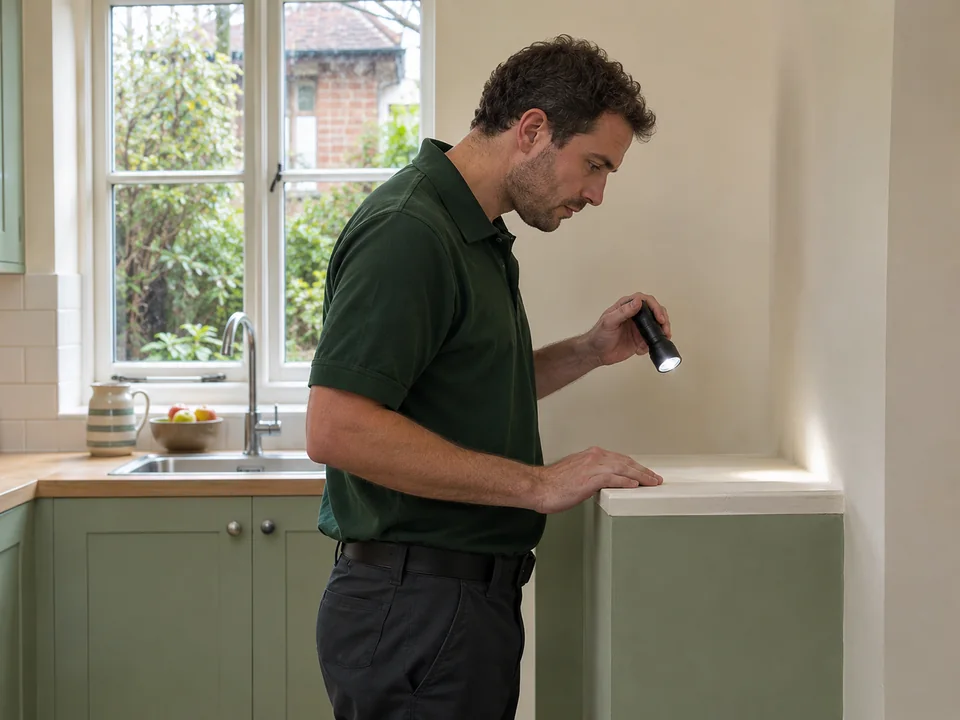
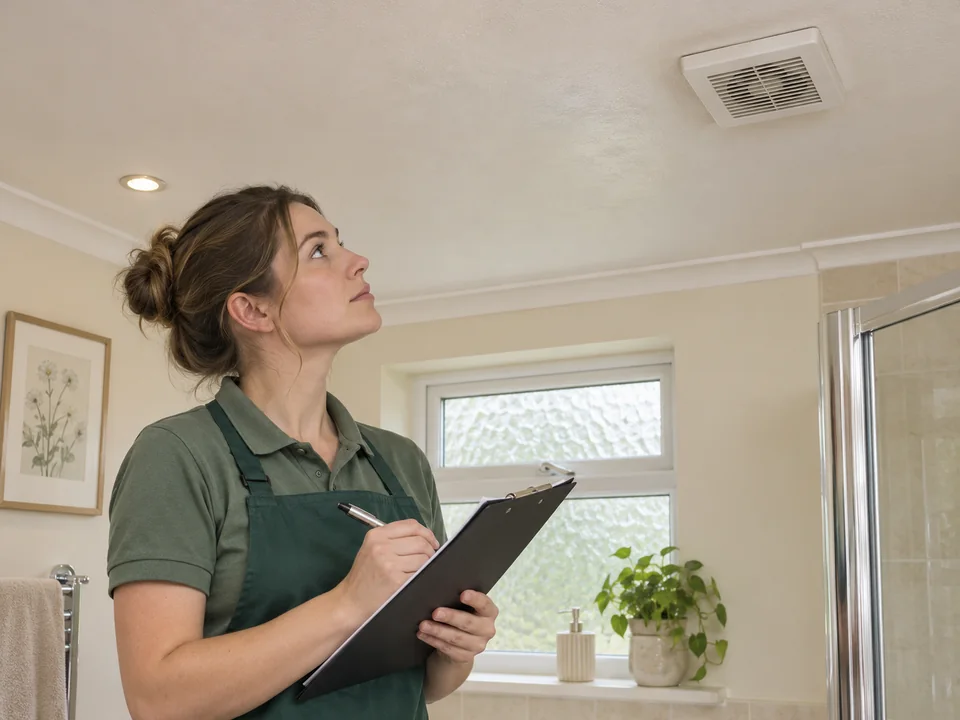
We assess what is exposed and distinguish one material from the next. Along a painted bay, a mark on a hard sill can continue onto a face with blistered or lifted paint. Along a shower, a stable non-porous tile may be suitable for cleaning while a dark join at the tray can be deteriorated. We tell you where we can work based on the visible finish and condition. If you know a surface has particular care requirements, point them out before we agree it.
Show us where the affected patch stops, or say where the view becomes limited. A deep sill beside an opening casement can have a clearly visible front lip while the narrow side beyond it still sits behind a fitting. We look from a position we can access and explain where it would be unsafe or impractical to reach. That is important where the mark follows a corner, continues behind a bath screen or may be present inside a closed service void.
If the mark appears under a fitting that has recently leaked, let us know whether anybody has already looked at the leak. Tell us which parts have dried and if a surface remains softened or swollen. What we can see at the appointment helps us agree cleaning of an accessible finish. If the source of moisture is unresolved and hidden, that finding needs an appropriate property inspection arranged independently.
| Exposed condition | Point we agree with you |
|---|---|
| Intact hard face | Which reachable area is suitable for cleaning |
| Soft or blistered board | How much of the adjoining area can be addressed |
| Mark beyond a fixed fitting | Where the accessible work ends |
Clean the agreed areas face by face
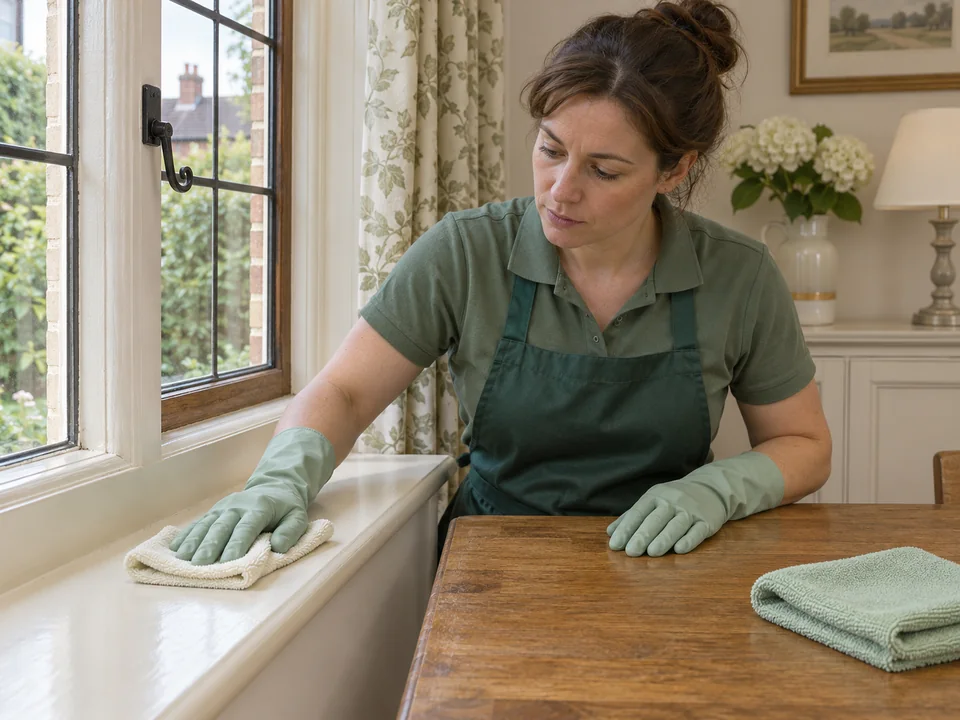
After the assessment, we remove visible mould from the suitable accessible hard surfaces you have agreed. We work on the defined faces in the room and compare them with the original description. At a kitchen window, the agreed work might cover a wipeable sill and a suitable adjoining edge. At a shower, the tiled face and the accessible screen surround can each be discussed on their own merits. There is a clear point at which work on one finish ends and an adjoining material begins.
If clearing a set of loose items reveals another suitable area, we agree any change with you before working beyond the original request. Tell us if new work needs to be approved by the owner or a managing agent. This is particularly helpful if the resident arranged entry and the booking contact is working elsewhere. We can identify which area was in the first agreement and say what we believe should be added for the contact to decide.
We may see a surface that looks different once it is viewed directly in good light. A dark edge can include discolouration within a coating or join as well as material on the face. Show us any worn, scratched or sensitive areas you already know about. We explain the expected result for the surface in its current state, and note any visible patch that appears connected with the condition of the finish itself.
For a property between occupants, let us know which fittings and stored equipment are still present rather than assuming each room will be empty. An appliance left for the incoming resident can occupy the same corner where the work was described. Agree when we can see the room as it will be on the day and provide the details of whoever will meet us there. We then assess the visible area with the actual room layout in front of us.
- Check which side of an affected join is included.
- Name the person who can approve an additional area.
- Point out parts of the finish you know have worn or changed.
Review the result and plan any next conversation
At handover, we go through the areas worked on and show where an obstruction or damaged finish limited the cleaning. If you originally described the problem as one long mark, we can identify the different surfaces and explain what happened to each. This is useful when you have promised the tenant, owner or property manager an update. If the booking contact cannot join us, arrange in advance who can receive the review and how we should get in touch.
For a mark that has appeared several times, keep its position clear when speaking to the person responsible for the home. A description such as the corner below the right kitchen window handle can identify the spot more readily than a general report about the window. We can describe the visible areas we cleaned and point out any remaining conditions we observed. That information helps the property contact decide whether to arrange further checks on a damp or deteriorated building element.
To discuss a quote, send us the complete address, the number of affected rooms and the condition of the visible finishes. Describe how much space we have around the area, especially where a front stair, closely fitted unit or glass panel affects the approach. The visit is priced on the work and access involved. A single long join with an awkward approach and two small exposed areas can lead to different cleaning plans.
- Ask us to show you the rooms in the order quoted.
- Agree who needs a handover if you are away.
- Pass on the precise location of any recurring mark.
| Handover item | Detail we can discuss |
|---|---|
| Work completed | The agreed exposed faces we reached |
| Marks remaining | Location and visible condition of the finish |
| Next contact | The person receiving the review or arranging a further inspection |
Questions about arranging mould removal
Can you look at a marked window recess in a side-return kitchen?
Yes, tell us which face shows the mark and what is in front of the recess so we can discuss visibility and access.
Can I send a description without knowing the material?
Yes. Give us its appearance and location. We look at the exposed finish before agreeing what can be cleaned.
What if the patch meets wood and a hard tiled face?
We assess both visible surfaces and look at how they meet. We then discuss which accessible areas are suitable and what you can expect at each edge.
Can I arrange cleaning before the new occupier moves in?
Give us the postcode and the expected handover date. Tell us who has the key and which fixtures will still be present when we attend.
Does your handover include areas behind fixed cabinets?
We report the areas we saw and worked on. We can also identify where a fixed cabinet prevented us from viewing the surface.
What should I say about a downstairs entrance next to the front steps?
Send the postal address and describe which set of steps or gate reaches the entrance, including who should open it.
Other Cleaning Services in Fulham
Regular housekeeping in Fulham, End of tenancy cleaning in Fulham