 Housekeeper
Detail-led care for your oven
Oven Cleaning in Fitzrovia
If your oven sits in a fitted run of glass, metal and cupboard fronts, identify exactly which surfaces need attention. A Fitzrovia oven cleaning enquiry can include individual cavities, appropriate removable parts and separately agreed nearby appliances. Share the model information and the approved approach to your home.
Can I enquire for a flat in W1T or W1W?
Send the complete residential address and the visitor entrance, so we can check the property.
Can I ask about a specific door finish?
Yes. Give the model, finish and position of the mark for the initial assessment.
Start with the part of the installation that needs care
A fitted kitchen can present a single line of glass that includes an oven, a compact grill or combination appliance and a warming drawer. Take an image of the full arrangement before pointing out the affected area. Write each door’s purpose and position and show the maker’s controls. If you can see the model at the door frame or find it in the paperwork, include that reference. Keep the appliances where they are instead of removing anything to find a hidden identification label.
A mark on a decorative surround may sit outside the oven, even though the border looks continuous with the door. Tell us whether it is on the cooker, where its trim meets the cabinet or on a separate panel. The appliance and kitchen companies may give different care information. If you want to enquire about something outside the oven, ask for it to be put on a separate line. This is especially helpful when more than one installer or manufacturer supplied pieces that share the same visual finish.
- Photograph the complete oven installation.
- Give the model or care instructions if available.
- Identify any surface beside the oven separately.
Write down the instructions on your fitted finishes
Check the appliance handbook for full descriptions of coated or textured surfaces. The use of an automatic cleaning programme can matter alongside information about what covers the interior. Tell us whether you have a catalytic liner or a maker-specific cleaning surface, and give the current condition where visible. A light burn mark on a glazed panel can be hard to tell apart from pale wear at the edge of a tray. Before deciding what can be treated, the technician can assess the affected finish and accessible material around it.
If you have applied a household cleaner since the mark appeared, give its name and explain which part it touched. Mention the time that has passed and any cooking cycle since. Make a separate note for each cavity if you used a different treatment on the upper and lower ovens. A permanent change in a finish may stay visible after accessible grease or food residue has been cleaned. Give us enough detail to discuss that possibility during the visit, especially if the main concern is how the appliance looks from the kitchen.
Identify finishes on a fitted cooker
| Area | Information to provide | What can be checked |
|---|---|---|
| Glass front | Door position and edge condition | Access by design and condition |
| Part of the inner lining | Care page and type of coating | Appropriate surface method |
| Matching cabinet trim | Which finish it belongs to | Separate item if requested |
Show the difference between regular use and a one-off incident
The shape of the deposit is sometimes more useful than an estimate of how dirty the oven is. A spill may run beneath a rack and harden near the door, while repeated roasting can leave a film in several places. Describe the part that first attracted your attention and how you know which surface it occupies. Take a picture from the opening after the appliance has cooled. Include a closer image only if the surface can be seen safely without moving an attached part or reaching past a fitted component.
When the oven is one of a pair, pair the photo with a short description of your cooking routine. This tells us why a side oven looks almost untouched and the main one has deep marks on a particular level. Take note of where trays and racks normally sit. If a recent spill prompted the enquiry but an older mark on another surface also matters, make that clear rather than assuming the technician will place equal weight on every mark at the initial inspection.
- Identify any individual spill separately from general grease.
- Name the shelf or part nearest the mark.
- Distinguish recent instructions and treatments by cavity.
Point out the fittings before they are moved
Take a count of original shelves, runner types and trays. A sliding mechanism built into an accessory can need a different check from a wire rack you lift away. Flag any fixing that feels unusual during normal use and leave it in its current position for the technician. Give the manual if a rail has a particular release or finish. Suitable removable components can be taken out once checked and may be soaked in a dip tank. Parts with an uncertain coating or condition need their own assessment.
Remove food and personal cookware from the cold oven before the visit, and keep the working surface as clear as possible. If you have a spare shelf or pan that normally lives in a drawer, tell us why you want it included. A non-original tray may differ substantially from the parts supplied with the oven. Ask which accessories are agreed on the quote and leave them identifiable. Make space where those items can be handled without placing them on a vulnerable cabinet front or crowding the cooker.
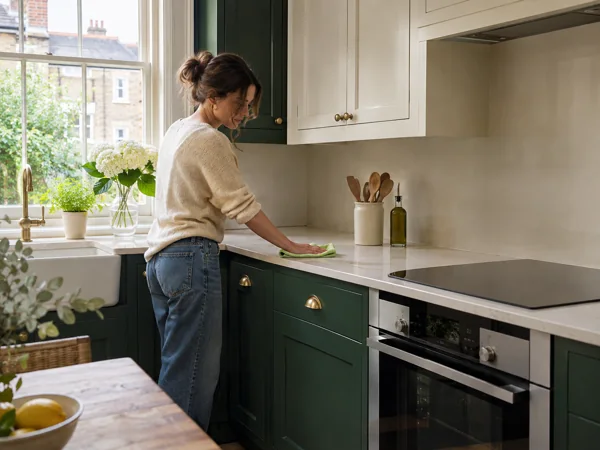
Map the work to each unit
| Unit | Photo or note to send | Decision to discuss |
|---|---|---|
| Main oven | Front and model | Cavity and accessories to include |
| Compact grill | Controls and type of internal finish | Treatment and access to parts |
| Extractor | Height and cover or filter | Reachability and item list |
Ask the glass question as a distinct part of the job
If haze on a door is the main concern, note its position relative to the handle and visible outer edges. Describe whether light from the window makes it stand out, and take a picture from the side if that helps show a plane of residue. The mark may be on an accessible face or between panes. Careful assessment is needed to determine which side is visible and whether the door can safely be handled for access, taking its model and present condition into account.
Avoid pulling the trim forward to see further in. Report any chip, loose edge or known earlier work on the glass. If the concern is on a patterned area at the border rather than the clear centre, point that out. The technician can examine where the marking starts and whether the finish itself has changed. Ask what can be done on the accessible faces before agreeing any further work on the door. In a stack of appliances, label the photo with the correct door and keep the relevant maker’s information nearby.
- Show whether the mark is visible on the closed door.
- Point out signs of damage or earlier work.
- Discuss what can be reached before adding extra work.
Differentiate the Fitzrovia postal address and the usable door
Westminster City Council’s Cleveland Street conservation area audit describes streets spreading beyond Fitzroy Square including Cleveland Street, and identifies that street as the boundary between the two boroughs in that part of Fitzrovia. For an appointment, give the postal address for your home and the specific entrance a technician should use. If a ground floor is signed for commercial visitors but the flat uses a separate door, identify the latter by its bell and the street it opens onto. A local reference should clarify the approach to the property.
For a shared building, confirm the equipment route with reception or the property contact. Give the name or number displayed at the approved entrance. Explain any access arrangement that applies for a small time window and whether registration or a pass is needed. Include the authorised lift, any steps after it and who can open a second internal door. If an occupant is home but cannot meet visitors downstairs, work out where a different contact can pick up the technician and how to reach them.
Give other appliances separate care decisions
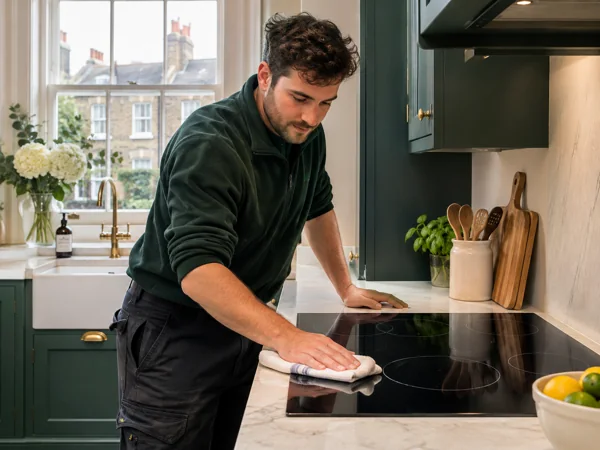
Describe what the hob is made of and give a distinct reference if it belongs to a different manufacturer from the oven. List removable supports, areas around the controls and any other reachable surface you want assessed. If a hob is partly surrounded by stone edging or a fabricated panel, ask about that material on its own line. A stain at the join can extend across finishes that need different handling. The quote should make clear which areas of the cooking surface or trim are included.
Tell us how the extractor is fitted and at what height. Include the filter type if you know it and say whether you are concerned with the cover or the recessed part. The accessible portions of a hood may be different on an island and a cupboard-mounted model. Send a picture from a steady position to explain the arrangement. Confirm what belongs on the quote separately, especially if you need us to work around a finished surround or if the holder for the filter is hard to reach.
- Identify the cooking surface and supports.
- Give the extractor height and filter details.
- Check the optional items against the quote.
Make a residential arrival note
| Stage | What to provide | Who confirms it |
|---|---|---|
| Outside | Postal address and entrance bell | Occupant or agent |
| Reception | Approved door and lift for equipment | Building contact |
| Kitchen | Clear space beside the oven | Person at the property |
Plan the handover for a fitted kitchen
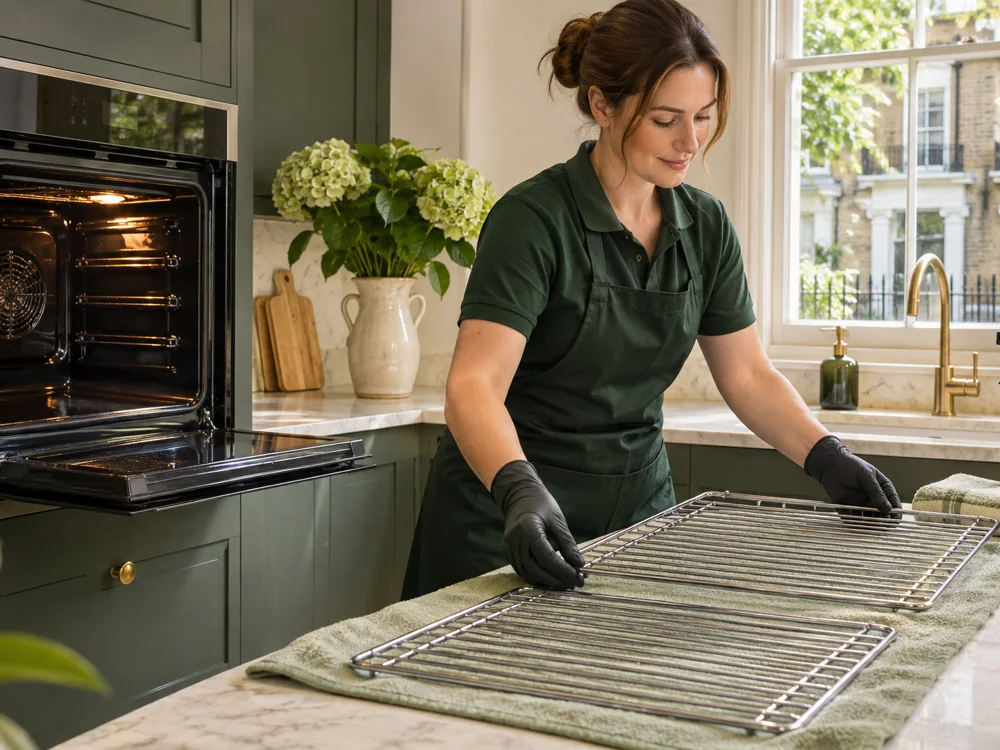
Begin with the full postcode, then share the appliance picture, care information and confirmed access route. Let the oven cool and clear the working surface before the technician arrives. Remove loose items near the door and leave a path into the room. Keep children and pets away while parts are being handled, and mention in advance if the route to the only utility room passes close to the oven. Decide who can speak for the household if the first assessment raises a question.
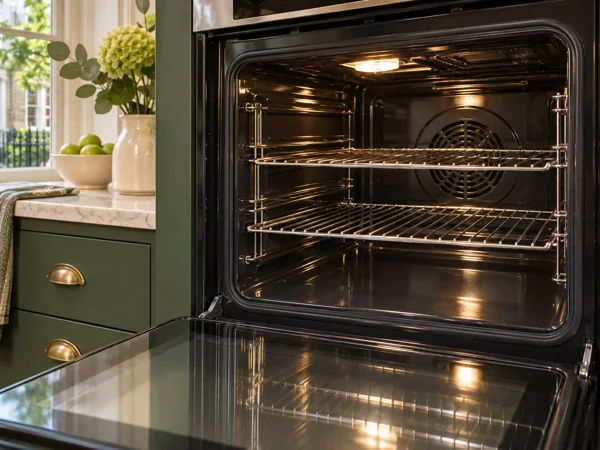
Ask which parts were cleaned and what the technician advises before you put the oven back into use. Keep the relevant shelf and tray positions clear for whoever is cooking next. If a finish was outside the agreed work, save its exact location and instructions for later rather than treating it as a mark that has newly appeared. If someone else is managing access, ask them to send you the final item list and instructions. Make sure any visitor pass is returned in the way the building requires.
Get an oven cleaning quote in Fitzrovia
Request a quote with the oven type, number of cavities and any extra appliances.
Get a QuoteOther Cleaning Services in Fitzrovia
Local references · Westminster City Council, Cleveland Street Conservation Area Audit
Fitzrovia oven cleaning questions
Do I need to include a separate warming drawer?
Only if you want it considered. Identify the door, describe its purpose and ask about it separately.
What if the trim and oven front look like one panel?
Send a wide picture and identify exactly where the mark is. Share instructions for the surrounding material if available.
Can an integrated extractor be discussed without removing its cover?
Yes. Send its position, height and known filter type or model. The technician can assess suitable access.
Which information is useful if the flat entrance is separate from a shop?
Give the exact street, building number and residential bell, as well as the full postal address.
Should I handle a sliding rail to show the problem?
Leave it in place if it catches. Explain where the issue occurs in normal use.
Can the oven be used by a guest after the clean?
Ask the technician when it can be used again and share the instructions with the guest.