 Housekeeper
Signature care for well-used ovens
Oven Cleaning in Tooting
Plan care for the oven you rely on in your Tooting home. Tell us if a shelf has become awkward to slide, if the grill has different fittings, or if the glass is the main concern. We can discuss the accessible parts, their finishes and the approach to your kitchen from the full postcode.
Can I enquire from a home in SW17?
Send the whole postcode and name the residential door so we can check the address.
Do you need the oven handbook?
Share it if you have it, especially for coated liners or special shelf fittings.
Choose the right oven for the first visit
If a fitted kitchen holds both an everyday oven and a compact grill, describe which one started the enquiry. A dirty tray in the smaller compartment or residue gathering along the lower edge of the main door can be more specific than a request to clean everything. Name the affected cavity using the controls and position of the door. Send the manufacturer and model from available paperwork or a label you can see without moving the unit. Ask for separate lines if you want both compartments considered.
Sometimes the second appliance is only used when several dishes must finish at the same time. In that case, you may choose to focus the visit on the hardworking oven and discuss a separate grill or extra cavity later. Tell us about cooking modes if the upper unit also works as a microwave or has a steam setting. Its finish and fittings may require different care. A broad front photograph allows us to match your description to the layout before discussing the quote.
- Identify the appliance by its door and controls.
- Include relevant model and care information.
- Name every oven or grill you want assessed.
Show where the concern starts
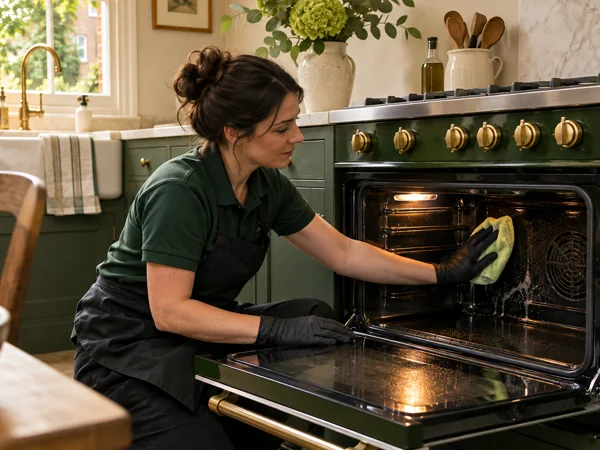
Once the oven is cool, look at the area that prompted the booking and describe the parts around it. A layer on an ordinary enamel surface can look much the same as a dark mark on a removable liner, but the technician needs to know which surface is involved. Write down where the middle shelf sits and describe any spill that reached the base or the area beside the door edge. If a mark is thin at one end and thick at another, describe both.
Say when you last ran a self-clean cycle or used an oven cleaning product, where you applied it and what happened afterwards. Keep any relevant manufacturer directions. The mark could be cooking residue, permanent discolouration or wear of the surface. The technician can review where it sits and explain what cleaning may change. If the oven has two cavities with an issue in each, label the photos with the cavity rather than letting the person who opens the door guess which picture goes where.
Identify shelf fittings and coated parts
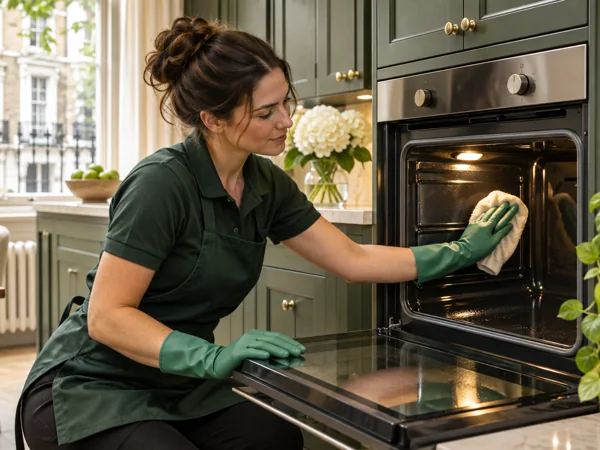
Two shelves can have the same width but different fixing arrangements. A plain wire rack may slide out readily while a rail that extends may need assessment at the points where it attaches. If an accessory appears loose or has started to catch, describe the position and leave it in place for inspection. Tell the technician if the maker’s guidance limits wet treatment or handling of a special part. That information can change the choice both inside the oven and for any parts removed from it.
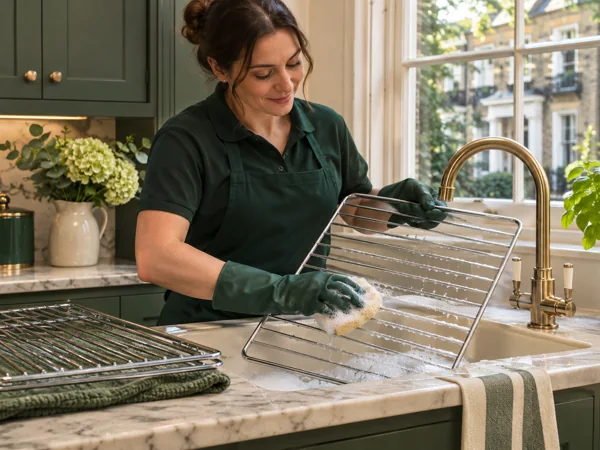
Count individual racks and trays and list unexpected items separately. An old grill tray that sits inside a newer appliance may be a different finish from the original. The technician examines the condition and construction and may remove suitable components, then use a dip tank for pieces that can be soaked. It helps if you can point out the accessories you intend to use again so the technician can explain how they were handled. Empty the cold oven of food and loose cookware ahead of the visit.
- Count trays, inserts and racks separately.
- Flag any moving rail that catches.
- Share instructions for a coated or unusual part.
Identify the appliance or part
| Question | Detail to supply | What the detail confirms |
|---|---|---|
| Which oven? | Door position and controls | Cavity for the quote |
| Which finish? | Maker’s care page | Material to assess |
| Which rack? | Width and fitting type | How it should be handled |
Describe the glass under the light you normally use
If the marks show up only when a kitchen lamp is on, point that out. Take an image with the cool oven open if the stain is visible from inside and another with the door closed. This may help tell whether the concern is a cooked film on an accessible face or a mark visible deeper in the door. The safe approach depends on the door’s build and condition. Mention earlier work on the door and any movement of the trim when it is normally opened.
It is worth being specific about a single mark if that is the main reason you are booking. Different ovens offer different access to the glass between panes. If a clear photograph is difficult, explain where to stand and where the light comes from. Give the manual to the technician if it explains the door construction. Leave the glass and its fittings in place while the assessment is made, and ask which faces will be included before you commit to the work.
Use the right approach off Tooting High Street
Transport for London places Tooting Broadway Underground Station on Tooting High Street in SW17. A nearby landmark can help the technician orient a route, but give the door that serves the home and its full postcode. If the front of your building has a business entrance, explain where the residential door sits in relation to it. Describe what is written on the bell and whether the door leads directly to the property or into a passage that serves several households.
Check who can meet the technician, where equipment can be unloaded and whether there are internal steps after a shared entrance. If you need to use a side gate to reach the kitchen, explain how it opens and where the house number can be seen. In a small flat, the approach may have a turn where a hallway table can obstruct a clear path. Address that before arrival. If the way in depends on a neighbour or building contact, arrange their availability before agreeing the slot.
- Give the visible name or number on the residential door.
- Identify a gate or later flight of steps.
- State who can meet the technician at the agreed entrance.
Prepare a clear working area around the cooker
Leave the oven off and cool before the appointment. Clear any baskets or utensils on the worktop and remove things close to the door so it can open. If your cooking area is beside the only exit to a garden or utility space, plan when you need access and tell us. A technician may need a short discussion about where equipment and removable parts can sit, so describe the room and availability of facilities when you enquire.
A compact kitchen can offer enough space for someone to cook yet be awkward when a grill door and oven door both have to be opened. Test the space visually and move light household objects where they will stay out of the way. Make another place for children and pets while the work is in progress. If you are expecting a delivery or someone else needs to cross the kitchen, agree a different route before the visit. That gives the technician a clear place to assess the cooker and handle parts.

Locate changes to the glass
| Observation | Helpful evidence | What to discuss |
|---|---|---|
| Visible with door open | Photo from cavity opening | Access to inner face |
| Visible by kitchen lamp | Lamp position and angle | Likely position of residue |
| Trim shifts | Describe where it moves | Condition before handling |
Ask for the cooking surface and hood independently
For some enquiries, the area most in need of attention is the hob directly above the oven. Say if it is a glass surface, a gas hob with cast supports or a plate built into the range. Name any particular surround or splashback only if you would like to ask about it. When sharing an image, highlight the edge where you see residue and give the manufacturer’s advice for a finish with special requirements. List the hob as an optional item alongside the cavities.
An extractor might be integrated into the cupboard or hung high where the filter is hard to see. Give its approximate height and the type of filter if you know it. A reachable metal cover and an internal or disposable insert are separate things to discuss. Ask for the quote to identify any agreed parts for the hob and extractor. If there is another oven or cooker top in a different room, send the separate appliance layout before trying to put all the items under one heading.
- Describe each finish or part separately.
- Include the position of the extractor and filter.
- Ask for the optional items in writing.
Gather the details for before and after the clean
Start with the full postcode when requesting a quote. Have the cupboard or appliance reference and an access note ready. If the appliance layout is unfamiliar to the person opening the door, share a picture marking the correct oven. Agree who has authority to answer a question if the technician identifies a part that cannot safely be removed. Where the oven is a source of daily meals, tell us which cooking time is important and plan to check when it can be put back in use.
When the work finishes, ask which areas were assessed and which parts have been cleaned. Check where the accessory pieces go and pass on the technician’s return-to-use advice to everyone who uses the oven. If a mark remains because the surface has changed, record which cavity it sits in for future reference. A short confirmation also helps when you have asked about a separate grill or extractor before finalising the quote. Keep the manufacturer instructions together with any details the technician noted about the cookware and fittings.

Practical access in Tooting
| Stage | Detail to provide | Reason |
|---|---|---|
| From street | Full postcode and residential door | Matches the actual property |
| Through building | Hall, gate or flight count | Clarifies equipment route |
| At the kitchen | Space beside the appliance | Allows room to inspect parts |
Get an oven cleaning quote in Tooting
Request a quote with the oven type, number of cavities and any extra appliances.
Get a QuoteOther Cleaning Services in Tooting
Local references · Transport for London, Tooting Broadway Underground Station
Tooting oven cleaning questions
Can I fit the visit around another cooker in the kitchen?
Explain where the two appliances sit and when you need to reach them so access can be discussed.
Should I identify a homemade foil liner?
If there is loose foil in the cool oven, remove it. If anything has stuck to the finish, point it out during the assessment.
Can the technician look at one side of the glass only?
Yes. Describe which face concerns you and ask for the accessible surface to be listed.
What do I say if the cooker has lost a shelf?
List the racks you still have and tell us which slots are normally used.
What if the main door opens directly onto the High Street but the flat is round the corner?
Give the full address and the intersecting street or visible door sign for the flat.
Can I leave the extractor out even if there is a hob on the quote?
Yes. Name each item individually so only the agreed work appears on the quote.