 Housekeeper
Detail-led care for your oven
Oven Cleaning in Greenwich
Plan an oven clean in Greenwich around the layout of your fitted kitchen. Tell us which doors lead to the cavities or grill you want assessed, then identify the coatings, trays and other parts that need attention. Include the actual property entrance and the next time you need to cook.
Can I ask for an oven quote in Greenwich if my flat has a concierge?
Yes. Provide your full postcode, the building name, visitor entrance and any approved lift or unloading route.
Can you discuss the finish of an enamelled cavity and the door separately?
Yes. Send the model, photos and any care instructions so the surfaces can be identified and assessed individually.
Name the installation you want us to look at
A kitchen can have one oven set beneath the worktop and another appliance with a matching front at eye height. Point to the one you want cleaned in a photograph that shows the cabinet layout. Identify a separate grill if you use it, and say which other compartments should be considered. On a fitted range, describe the doors from left to right and explain where the main and smaller ovens are. A warming drawer or storage panel can look like a cavity until the overall appliance is shown.
Send the maker and model from the appliance papers or a visible mark near the door. Leave the cooker in its fitted position. Where an older model has replacement shelves or a new grill pan, identify the relevant pieces so they can be assessed by their finish and current condition. A list with the number of enclosed cavities is helpful even when you have already sent several photos. If access to the cooker differs when the door is open, include a side view or a plain description of the surrounding space.
- Use one photo of the complete appliance bank.
- Name each door you want assessed.
- Identify aftermarket racks and trays.
Give Greenwich directions that end at your own doorway
The Royal Borough of Greenwich describes Greenwich Park’s outlook over Docklands and the City. People use the park as a landmark from several approaches, so it helps to give the full postcode and the actual entrance to the property. For a street-level doorway with several bell labels, identify the one that lets the technician into the right building. If the usual door is around a corner from the postal street, send that instruction alongside the postal address. Mention any internal steps before the person reaches the kitchen.
If a flat is in a development with more than one set of lifts, the reception route for visitors can differ from the route residents use. Check who can point the technician to the correct core. In a divided property, find out who can open the second door and whether it closes automatically. When a short delivery bay is the only place to unload, explain the position and discuss whether someone can meet the technician. Tell us if the kitchen entrance can be reached from a shared courtyard rather than from the main hall.
- Include the full postcode, bell label and kitchen floor.
- Confirm which entry a visitor is expected to use.
- Give the building contact for shared access.
Identify fittings in a built-in kitchen
| Part | Details to send | What to confirm |
|---|---|---|
| Eye-level oven | Position relative to other appliances | Number of doors covered by quote |
| Under-worktop grill | Separate controls and tray | Which loose pieces are included |
| Extractor canopy | Height and filter type | Reachable outside panels and filters |
Discuss the surfaces before treating a mark
An enamelled interior and a specialist side liner can appear to have the same sheen when lit from above. Check the manufacturer’s guidance for your appliance if you know the lining is self-cleaning or catalytic. Describe where a previous product was used or where a spill started. If a dark mark sits on two adjoining surfaces, send a photo that shows the join. It can help the technician see which areas have different care requirements and separate hardened cooking residue from an existing change to the surface.
Explain whether the appliance was used after you noticed the mark and whether you have run a self-cleaning cycle recently. A dark area may be discolouration or a change in a coating. The technician can discuss this after inspecting the oven and can explain which parts are suitable for treatment. Mention any unusual condition such as a damaged seal, worn control label or a panel that no longer sits evenly. A fault with heating or ignition should be raised with a qualified appliance specialist separately, and shared before you agree the cleaning appointment.
Match the cleaning discussion to each oven shelf and tray
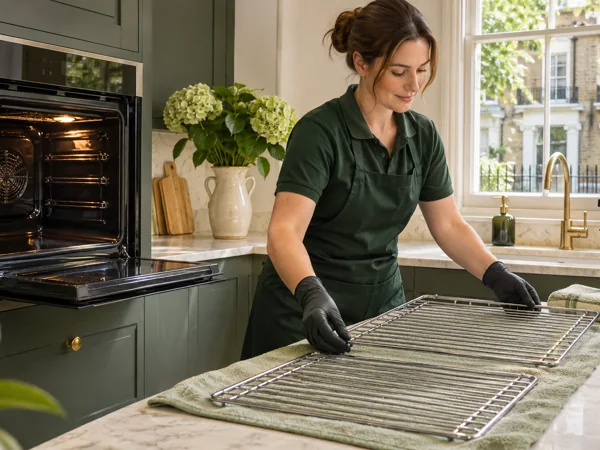
When the oven is cool, look at the normal positions of the shelves and any tray that belongs with the grill. Select the pieces you would like considered and note where they are stored. Suitable removable components may be taken out for separate cleaning, including soaking in a dip tank where appropriate. Which pieces can be treated this way depends on their construction, coating and condition. Include extra accessories if you want them considered, including anything bought later in a different material.
If a grill pan handle normally lifts away, show the parts together. A sliding rail that stays on a side support may need different handling from a basic wire shelf. Leave any fitted item in position when you do not know how it comes out. Tell the technician if a rack catches or drops while moving, or if a coated tray has a loose patch. When two cavities share the same general shape, label their parts separately before laying out the pieces requested.
- Keep each shelf set beside the relevant oven description.
- Identify separate inlays, supports and handles.
- Check loose pieces for wear that should be mentioned.
Describe visible finishes
| Finish | Existing concern | What can be assessed |
|---|---|---|
| Enamel panel | Burnt patch alongside a liner | Residue and surface condition |
| Brushed metal | Marks around the handle | Care needed for the finish |
| Glass insert | Streak visible only at an angle | Where it sits and likely access |
Locate the grease on an oven door or the surrounding trim
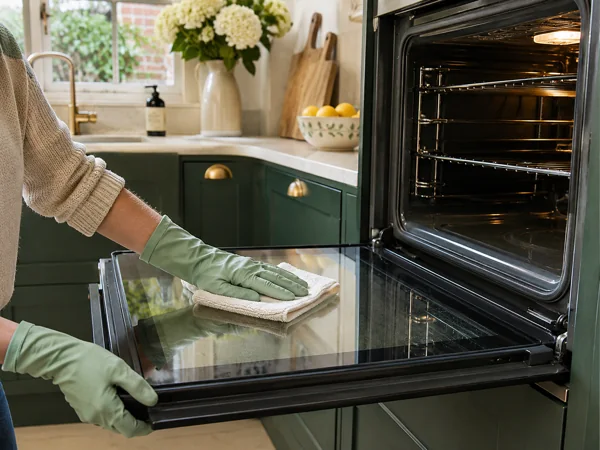
Show the position of a cloudy patch, streak or splash when the door is open and closed. One mark can be on the glass facing towards the oven while another can sit deeper in a gap where several panes meet. Avoid removing a cover by yourself to work out its position. Tell us if the door has replacement glass or if a seal or hinge was altered, and let the technician assess which parts can be reached. Include a photograph of the outer surround when that surface is part of your concern.
A panel with printed controls or brushed metal at the top of the door can have its own care requirements. If lettering has already worn away, show the affected buttons before work starts. Point out any lacquered cupboards close to the appliance or details around the handle where you already know of an issue. If the cabinet trim has lifted or catches the door when it opens, let us know when describing the working area. An overall photograph can be more useful than a close-up alone for explaining how those finishes fit together.
List an additional hob or extractor by its own model and finish
If your cooker arrangement includes an induction hob, state the surface, its approximate width and the position of marks you want discussed. With gas, give the number of pan supports and mention any easily removed parts you would like assessed. On a range with a separate griddle, tell us how it fits and which finish it has. If the hob shares controls with the oven, include that in the overall photo. Ask for the hob and any extra components to be considered as separately named items.
A compact hood can be hidden underneath a wall cabinet or within a built-in canopy. Show its approximate height, location relative to the oven and the type of filter if known. For an extractor with more than one panel, distinguish between the visible surfaces and the filter inside. Let us know about shelves or cabinets that affect access. Ask about the treatment of a metal filter in comparison to a disposable insert and confirm what has been agreed on the quote.
- Describe hob type, finish and relevant removable parts.
- Show how to reach the extractor and its visible panel.
- Request separate lines for the accessories and appliances.
Use the cooking plan to prepare for the appointment
Arrange for the cooker to be cold and out of use before the technician arrives. Move utensils and food off the nearby worktop and leave room for the doors to open. If the kitchen has a dining table nearby, explain whether it changes the working space. Remove loose foil, food and pans from the cavity and keep pets and children clear while the appliance and parts are being handled. Mention whether the cooktop or a separate microwave will need to stay accessible during the visit.
If you are planning to cook a meal after the clean, give the time when discussing the appointment. Confirm any water and power requirements before the day, especially in a property where other work will be happening in the kitchen. At the end, ask what has been cleaned, what has been left in place and when you can return the oven to use. If somebody else will be cooking, make sure they have those instructions and know which shelf or grill pan goes where.
- Clear the nearest worktop and door swing.
- Tell us when the oven needs to return to use.
- Arrange for someone to receive the handover.
Plan the route into a Greenwich flat
| Entry point | Useful detail | Who to ask |
|---|---|---|
| Entrance | Building label and bell | Resident |
| Reception | Visitor checks and approved lift | Concierge |
| Internal approach | Steps or doors after the lobby | Person meeting the technician |
Confirm the quote with the person who will open the door
Begin the enquiry with your full postcode and the appliance details on one list. Add a short note about the condition and mention the exact cavity, loose accessories and other appliances you want included. Explain if the kitchen entrance or the building contact changes from one day to another. If you are using an inventory, match a general label such as fitted cooker to the model and actual number of working compartments before deciding what you want considered.
Check the quote once you have discussed the options. Keep the agreed list with the photos and pass it to the person who will provide entry. If the plan depends on a shared lift or a service key, confirm who can make that available and whether there is room next to the cooker for an open door. For a property handover, tell us which dates matter for oven use and keys. Send updates if you add components or discover that a finish needs specialist assessment.
Get an oven cleaning quote in Greenwich
Request a quote with the oven type, number of cavities and any extra appliances.
Get a QuoteOther Cleaning Services in Greenwich
Local references · Royal Borough of Greenwich – Greenwich Park
Greenwich oven cleaning questions
Can you consider two oven cavities separately?
Yes. Identify each cavity, tell us which one is a priority and give the racks and trays that belong to it.
What if the glass has already been replaced?
Tell us where the replacement was made and highlight any loose glass or trim before the appliance is inspected.
Can you include an extractor with an unknown filter type?
Send the make or a clear picture from a safe position and explain how the extractor is reached.
How should I describe a wall of matching kitchen appliances?
Photograph the full wall and identify the oven or grill by its position and use.
Do I need to pull fitted racks out?
Leave fitted or stuck components in place and tell the technician what you know about their movement.
Should I use the postcode of a nearby landmark?
Use the full postcode for your own address and give the actual entrance visitors should use.